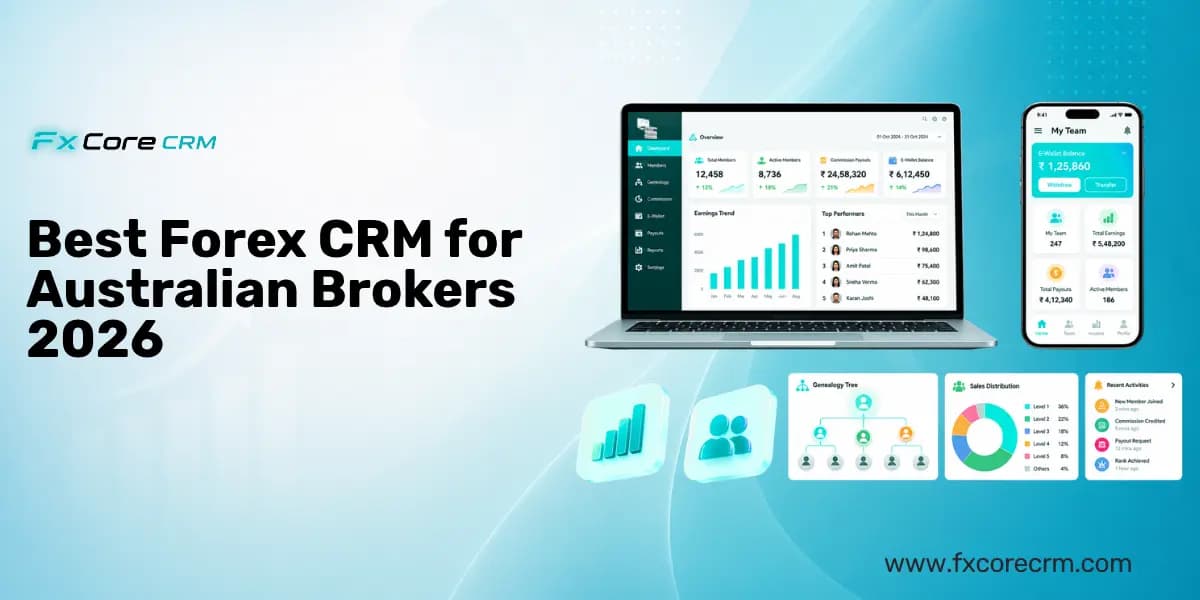
Best Forex CRM for Australian Brokers: ASIC Compliance Guide 2026
Australia is one of the most tightly regulated retail trading markets in the world. For a broker, that changes what you need from software. In many markets a CRM is mainly about speed and convenience. In Australia it also has to help you prove, to ASIC and to your own board, that your rules are being followed.
This guide covers what Australian brokers should look for in a forex CRM in 2026, where ASIC’s rules affect day-to-day operations, and the questions to ask any vendor before you sign.
This is a technology guide, not legal advice. Your licence conditions and obligations depend on your own structure, so confirm the details with an Australian financial services lawyer.
The Australian Market in Brief
Australian retail traders are experienced, and they expect a polished experience. Most trade on mobile, many hold accounts with more than one provider, and they are quick to complain publicly if a broker is slow or unclear.
Two things set Australia apart from most other markets:
- Licensing. Issuing CFDs to retail clients in Australia requires an Australian Financial Services Licence (AFSL). Brokers serving Australians from offshore are in a different position and should take advice on what is permitted.
- Product rules. ASIC regulates how CFDs can be offered to retail clients, not just who can offer them.
Both feed straight into how your CRM should be configured.
ASIC’s CFD Product Intervention Order
The most important rule set for CRM design is ASIC’s CFD product intervention order, which has applied since 29 March 2021. For retail clients it covers:
- Leverage limits. Maximum leverage ranges from 30:1 on major currency pairs down to 2:1 on crypto-asset CFDs, depending on the underlying asset
- Standardised margin close-out arrangements
- Negative balance protection
- A ban on certain inducements to open an account or to trade
The order does not apply to wholesale clients, so client classification matters.
The order is currently due to expire on 23 May 2027. ASIC has opened a consultation proposing to extend it, so brokers should plan on these protections continuing and watch for the final decision.
Get Free Demo
What This Means for Your CRM
1. Client classification must drive account setup
Retail and wholesale clients are treated differently, so the classification you record has to control what happens next. A good forex CRM maps each client category to the correct MT5 group, with the right leverage, margin close-out level and negative balance protection applied automatically. If staff pick groups by hand, someone will eventually put a retail client in a wholesale group.
When a client’s category changes, the group change and its record should happen together, with a timestamp and the name of whoever approved it.
2. Leverage and risk settings should be enforced, not remembered
Leverage limits live in your MT5 group configuration. The CRM’s job is to make sure every new account lands in the right group and to flag any account that doesn’t match its category. Regular exception reports are a simple, effective control.
3. Inducements need extra care
Because the order restricts inducements, features such as deposit bonuses, trading contests with prizes, and rewards for referrals need legal review before you use them with retail clients. This applies to any platform, including features like a contest manager. Make sure your CRM lets you switch these features off or limit them by client category, so you control where they apply.
4. Records must be complete and retrievable
If ASIC asks how a particular client was onboarded, categorised and treated, you should be able to show it quickly. That means an audit trail covering KYC decisions, classification changes, group assignments, deposits, withdrawals and communications, all linked to one client profile.
5. Onboarding must be solid and still quick
Australian clients are used to fast digital onboarding from banks and fintechs. A slow, email-based process loses them. At the same time you have identification and AML obligations to meet. The digital onboarding flow needs mobile document capture, automated screening, a compliance review queue and a full audit trail. Document types commonly seen in Australia include Australian driver licences, passports and proof of address, but confirm your accepted list with your compliance adviser.
Brokers should also check their obligations under Australia’s AML/CTF laws, which have been changing. Ask your compliance team which requirements apply and whether your KYC workflow reflects the latest rules.
6. Ongoing due diligence needs automation
Documents expire and client circumstances change. Automatic expiry tracking, renewal requests and account restrictions for lapsed documents keep your files current without someone maintaining a spreadsheet.
Features Australian Brokers Should Look For
Reliable MT5 and MT4 integration. Accounts should be created in the right group automatically after approval, balances should update in real time, and compliance status changes should flow to the trading server. See how a proper MT5 integration works and ask for a live demonstration.
A polished, mobile-ready client portal. Australian clients judge a broker partly by how its portal feels. The client portal should be fast on a phone, show accurate balances, and handle deposits, withdrawals and document uploads cleanly under your own branding.
Transparent IB and referrer management. If you work with introducers, you need clear records of who referred whom, what they are paid and why. The IB management module should calculate commissions from live trade data and let you trace each figure back to specific trades. Because remuneration rules for referral arrangements can be restrictive, take legal advice before setting commission structures.
Withdrawal controls. Structured approval workflows with destination matching and an audit trail protect both clients and the broker.
Local payment methods. Australian clients commonly expect bank transfer and PayID options alongside cards. Confirm which methods the platform’s gateways support and that deposits credit the account automatically.
Time-zone-friendly support. Sydney is several hours ahead of Dubai. Check that the provider’s support covers your trading and business hours, not just its own working day.
Questions to Ask Any CRM Vendor
- How do you map client categories to MT5 groups, and can I see that live?
- How do you prevent a retail client from being placed in a wholesale group?
- Can I disable bonuses, contests or other incentive features by client category?
- What does the audit trail record, and can you export it for a regulator?
- How does your KYC flow handle document expiry and re-verification?
- Can IB commissions be traced to individual trades?
- What is the support coverage for Australian hours, and what is the urgent-issue response time?
- What will the platform cost at my expected client volume in year one and year three?
Specific, demonstrated answers matter more than a long feature list.
Where FxCore CRM Fits
FxCore CRM is a Dubai-based forex CRM and back office platform for MT5 and MT4 brokers. For Australian operations, the relevant strengths are:
- Native MT5 integration with automatic provisioning to configured account groups
- Client category and group mapping, with change history
- Digital onboarding with AML screening, document expiry tracking and a full audit trail
- Unlimited-tier IB management with trade-level traceability
- Withdrawal approval workflows
- White-label, mobile-ready client portal on your own domain
- 24/7 technical support
Features such as copy trading, PAMM and the contest manager are built in, and you decide which to switch on. As noted above, take advice before using any incentive-style feature with Australian retail clients.
Request a demo configured around your licence structure and client categories: https://fxcorecrm.com/request-demo
Email: [email protected] | WhatsApp: +971 5557 14507
Frequently Asked Questions
Q: What does ASIC’s CFD order mean for my CRM?
It sets leverage limits, margin close-out rules, negative balance protection and inducement restrictions for retail CFD clients. Your CRM should apply the right account settings by client category and keep records that show it.
Q: Does the order apply to wholesale clients?
No. The order covers retail clients, so correct classification is important.
Q: Is the CFD order permanent?
It currently expires on 23 May 2027, and ASIC has opened a consultation on extending it. Check ASIC’s website for the latest position.
Q: Can I run trading contests or bonuses for Australian clients?
Take legal advice first. The order restricts inducements for retail clients, so these features need careful review.
Q: Does FxCore CRM support Australian brokers?
Yes. It supports MT5 group mapping by client category, digital onboarding with audit trails, IB management and withdrawal controls. Your own legal and compliance advisers should confirm your final configuration.
Get Free Demo
FxCore CRM is a forex technology provider headquartered in Dubai, UAE. The platform does not provide financial services, legal or investment advice. Brokers should take qualified Australian legal and compliance advice on licensing and ASIC requirements.