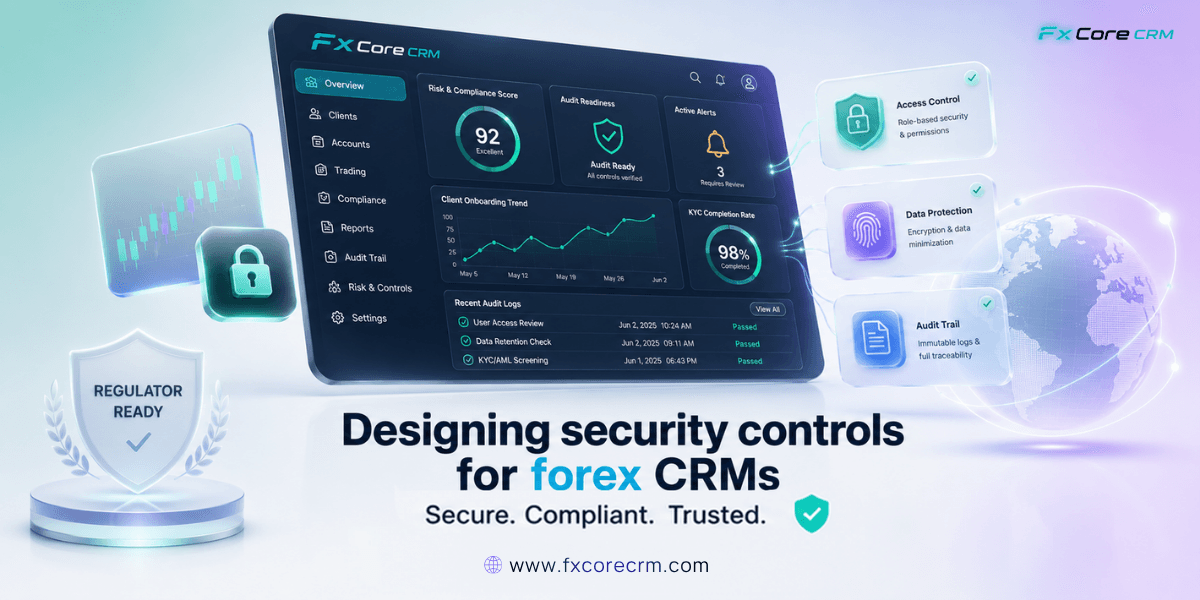
Forex broker security compliance usually fails long before an audit starts. It fails when a regulator asks for one client history, one withdrawal override, or one MT5 balance correction, and the brokerage needs three teams, four exports, and a spreadsheet to explain what happened.
Table of Contents
- What Forex Broker Security Compliance Actually Means in an Audit
- Forex Broker Security Compliance Check 1–3: Access, Approval Chains, and Audit Logs
- Forex Broker Security Compliance Check 4–5: KYC Evidence and MT4/MT5 Security Controls
- Forex Broker Security Compliance Check 6–7: PSP Controls, IB Access, and Multi-Entity Oversight
- FAQ
That is the real standard. Regulators do not inspect a broker's controls as a feature list. They test whether the firm can prove, quickly and clearly, that those controls worked across onboarding, payments, trading access, and staff actions. For compliance heads and COOs, that makes the CRM less of a convenience tool and more of an evidence engine.
The highest-risk gaps are rarely dramatic. They are ordinary operational shortcuts: over-permissioned staff, KYC decisions made in email, withdrawals approved in a PSP portal, or platform-side changes with no linked case record. When those shortcuts pile up, forex broker security compliance becomes hard to defend under CySEC, ASIC, FCA, or ESMA scrutiny.
The seven checks below focus on the parts of the broker operating model that most often break under inspection, starting with what compliance really means in an audit.
What Forex Broker Security Compliance Actually Means in an Audit
A broker can have policies, role tables, and approval rules on paper and still fail an inspection. Forex broker security compliance means the firm can reconstruct what happened, who did it, why it happened, and whether the action matched internal policy and regulatory expectations.
In practice, auditors test evidence under pressure. They may ask for a client onboarding trail, a record of staff permission changes over three months, or all manual trading-account interventions tied to one account group. If retrieval takes days, or if records conflict across systems, the control framework is already weak.
Why Forex Broker Security Compliance Depends on Evidence, Not Feature Lists
Regulators rarely accept statements like "the system has role-based access" or "all withdrawals require approval." They want timestamped proof. That means searchable records for:
- User logins and failed login attempts
- Role assignments and permission changes
- KYC reviewer actions and overrides
- Withdrawal approvals, rejections, and exception reasons
- Manual MT4/MT5 adjustments and linked approvers
A mid-tier broker processing 500 new accounts per month reduced KYC approval time from three days to under ten minutes after moving OCR, sanctions screening, and risk scoring into one workflow. The operational gain mattered, but the bigger improvement was auditability. The firm could show document receipt, screening outcome, reviewer identity, override notes, and final approval in one timeline.
That is the shift: forex broker security compliance is about evidence generation, not feature possession. The next question is how broad regulatory rules translate into actual CRM controls.
Get Free Demo
How CySEC, ASIC, FCA, and ESMA Translate into Broker CRM Security Controls
CySEC, ASIC, FCA, and ESMA use different rulebooks, but their operational expectations align around a few control areas:
- Access control: staff should only see and change what their role requires.
- Segregation of duties: high-risk actions need review and separation.
- Audit logging: critical actions must be recorded and retrievable.
- Record keeping: client and staff history must remain complete and searchable.
- Oversight: management must review exceptions, outsourcing, and privileged access.
- Retrieval speed: firms must produce coherent histories quickly.
The FCA SYSC sourcebook and ASIC RG 104 both point to systems-and-controls accountability, even if they do not prescribe one exact technical design. For brokers, that design usually lives inside a well-built forex CRM and its integrations. That is where the first three checks tend to fail.
Forex Broker Security Compliance Check 1–3: Access, Approval Chains, and Audit Logs
The first audit failures usually come from internal control weakness, not external attacks. Most brokers already know their cyber basics. What they miss is that forex broker security compliance breaks when too many people have broad rights, too few actions need secondary approval, and logs cannot explain what changed.
These are the controls that determine whether your operation stands up under inspection or collapses into manual reconstruction.
How to Design Broker CRM Security Controls for Least-Privilege Access
Least privilege only works when role design matches broker operations. Generic "admin," "finance," or "support" roles are too broad. Build permissions by function, entity, and data sensitivity.
A practical model includes separate rights for:
- Compliance: view full KYC, approve or reject onboarding, escalate high-risk clients
- Payments: review deposit and withdrawal requests, but not change KYC outcomes
- Support: view case status and masked client data only
- Dealing: view trading status and account restrictions, but not edit banking details
- IB managers: manage partner relationships and rebates, but not see full client documents
- IT or system admins: maintain technical settings without routine access to client PII
Entity-based controls matter just as much. A staff member supporting an offshore entity should not automatically access EU-regulated client records. If one CRM serves several jurisdictions, forex broker security compliance depends on strict entity segmentation, not a shared permission pool.
A common pitfall is the "temporary super-admin" that becomes permanent. Run quarterly access reviews and force documented approvals for every privileged role. If you are reworking permissions, learn about forex CRM features that support granular role design instead of flat user groups.
What Audit Logs Should a Forex Broker CRM Keep for CySEC or ASIC
A usable log captures who, what, when, where, and why. Anything less creates gaps. For forex broker security compliance, a CRM should record at minimum:
- Login, logout, failed login, IP, and session timestamps
- User creation, deactivation, password reset, MFA reset
- Role changes with old value, new value, approver, and reason
- KYC document upload, review, rejection, resubmission, and approval
- AML screening outcomes and risk-score changes
- Manual profile edits, bank detail changes, and status reactivations
- Deposit and withdrawal actions, including overrides
- IB commission rule changes, rebate edits, and reassignment events
Searchability matters as much as retention. An audit log that stores everything but cannot filter by client, user, entity, or date range is operationally weak.
One broker with 200+ IBs eliminated recurring commission disputes after replacing spreadsheet rebate tracking with automated multi-tier logs. The measurable result was not just fewer complaints. The broker could show exactly who changed a commission tier, when it changed, which clients were affected, and who approved the update. That is what regulators expect from forex broker security compliance as well.
Once access and logging are in place, the next weak point is onboarding evidence.
Forex Broker Security Compliance Check 4–5: KYC Evidence and MT4/MT5 Security Controls
A broker's onboarding and trading systems often operate as separate worlds. Auditors do not view them that way. They expect a clear line from KYC approval to account activation, funding rights, and any later platform-side intervention. If the CRM and MT4/MT5 records do not connect, forex broker security compliance remains incomplete.
How to Make KYC and AML Workflows Auditable Step by Step
"Approved" is not evidence. A defensible KYC workflow records each decision point:
- Document receipt with timestamp and file source
- OCR or manual extraction results
- Sanctions, PEP, and adverse-media screening outputs
- Risk scoring based on jurisdiction, payment method, and profile
- Reviewer action with notes
- Escalation to senior compliance where needed
- Override record with reason and approver
- Final decision and policy basis
This matters for both speed and defensibility. A broker that routes KYC through one controlled workflow can produce a full history in minutes. A broker that manages escalations through email cannot.
Build controls that block downstream actions when evidence is incomplete. For example:
- No live trading until identity verification is approved
- No withdrawal release if proof of address is expired
- Automatic review when a client changes country, payment method, or risk profile
If you are tightening onboarding evidence, KYC automation for brokers should focus on traceability, not only faster approvals. That creates the bridge to platform access, where many firms still rely on manual operator actions.
How to Align MT4/MT5 Security Controls with CRM Approval Records
MT4 and MT5 logs are valuable, but they do not tell the full compliance story on their own. A balance correction in Manager or Admin shows that something happened. It often does not explain who requested it, who approved it, or why it met policy. That gap is one of the most common failures in forex broker security compliance.
Link these platform-side actions back to CRM cases:
- Balance corrections
- Credit changes
- Account reactivations
- Trading disable/enable events
- Group changes or permission resets
The control standard should be simple: no manual platform intervention without a CRM case ID, requester, approver, operator, and reason code.
Also align timestamps across systems. Use synchronized UTC time and consistent account identifiers. Without this, even accurate logs become hard to reconcile.
For firms still relying on manual Manager actions, MT5 integration explained should include approval-chain mapping and sync-failure handling, not only account creation. That same cross-system discipline is even more important in payments and partner access.
Get Free Demo
Forex Broker Security Compliance Check 6–7: PSP Controls, IB Access, and Multi-Entity Oversight
The final control failures usually appear in the places where operational pressure is highest: withdrawals, PSP exceptions, partner requests, and cross-entity processing. This is where staff are most likely to take shortcuts, and where forex broker security compliance is easiest to undermine.
How to Control PSP Workflows and Trading Platform Data Protection in One Audit Trail
Payment controls fail when staff act directly in PSP dashboards and only update the CRM later, if at all. A clean process keeps the CRM as the decision record and the PSP as the execution layer.
A controlled workflow should include:
- Withdrawal request capture in CRM
- KYC and name-match validation
- Risk flag checks and AML alerts
- Tiered approval based on amount or risk score
- PSP submission with returned transaction ID
- Status sync back to CRM
- Exception path for holds, rejects, retries, and chargebacks
For failed deposits and withdrawals, configure retry logic with clear thresholds. If a card payment fails twice, for example, route the case to review instead of repeated blind retries. If a withdrawal is manually approved despite a mismatch, force a reason field and second approver.
A useful reference is keeping PSP data tied to client history rather than in separate payment spreadsheets. If you are reviewing this area, a PSP integration guide should cover exception controls, not just processor connectivity.
How to Restrict IB Access and Apply Forex Broker Security Compliance Across Multiple Entities
IB structures create two risks at once: privacy exposure and uncontrolled commission changes. The right model gives partners visibility into their own network performance without broad access to client files.
At minimum, restrict IB access through:
- Data masking for email, phone, ID, and banking details
- Client visibility limits to introduced accounts only
- Sub-IB segmentation by assigned hierarchy
- Commission-change logs with old rule, new rule, user, approver, and effective date
- No access to full KYC documents unless policy and jurisdiction explicitly allow it
A brokerage operating both a regulated entity and an offshore entity also needs separate approval paths. A withdrawal override acceptable in one structure may require enhanced review in another. Shared infrastructure is fine; shared controls are not. Forex broker security compliance depends on applying entity-specific rules for retention, approvals, and reporting views.
For brokers with active partner networks, our guide to IB management should be read from a control perspective as much as a revenue one. That leads directly to the questions compliance teams ask before an audit.
FAQ
What Evidence Do Regulators Need for Forex Broker Security?
They usually need timestamped, searchable records that show how controls worked in practice. That includes access history, KYC steps, payment approvals, manual platform interventions, and management oversight. For forex broker security compliance, the key test is whether your team can reconstruct a full event trail quickly.
How to Prepare for a CySEC or FCA Technology Audit?
Start with a mock audit. Pick a sample client and produce the full history from onboarding to funding to platform activity using only CRM, MT4/MT5, and PSP evidence. Then test privileged-access reviews, vendor-access logs, and approval-chain reports against CySEC and FCA expectations.
Can MT4 or MT5 Logs Alone Satisfy Forex Broker Security Compliance Requirements?
No. Platform logs show many actions, but they rarely provide the full compliance narrative. Forex broker security compliance needs linked evidence for requester, approver, policy basis, and related client-risk context, which usually sits outside the platform.
Can a CRM Vendor Become a Compliance Liability?
Yes. A vendor becomes a risk if support staff have broad undocumented access, if logs are incomplete, or if the system cannot produce clear records under deadline. Review outsourcing controls, support access, data-hosting arrangements, and incident handling as part of your compliance framework. Industry coverage from Finance Magnates regularly shows that regulatory pressure is extending further into technology governance.
How Often Should a Broker Review CRM Permissions, Vendor Access, and Audit Readiness?
Review permissions at least quarterly, and immediately after staff changes, entity changes, or new workflow launches. Review vendor access on the same cycle. Run a broader audit-readiness test at least twice a year, especially if your forex broker security compliance model depends on several integrated systems.
A broker that passes audits consistently does not wait for inspection letters before testing its evidence chain. It treats audit readiness as part of daily operations.
Forex broker security compliance is strongest when the CRM works as the central proof layer across access, KYC, payments, MT4/MT5 actions, IB controls, and multi-entity oversight. That is the practical lesson behind all seven checks: regulators want clear evidence, not assumptions, and retrieval speed matters almost as much as control design.
forex broker security complianceFor COOs and compliance heads, the next step is straightforward. Run a mock case review this week. Trace one client from onboarding to withdrawal to platform activity, then trace one staff member's permission history and one manual MT5 adjustment. If your team cannot produce those records within minutes, your framework needs immediate attention.
Get Free Demo