Every new forex broker faces this question at some point during the setup process.
Should we build our own forex CRM from scratch — custom developed, fully owned, built exactly to our specifications? Or should we buy a ready-made forex CRM solution, get operational quickly and invest our capital in client acquisition and business growth instead?
It sounds like a reasonable debate. In practice, for the overwhelming majority of new forex brokerages in 2026, it is not really a debate at all. But the reasoning matters — because brokers who choose to build without understanding what they are committing to end up eighteen months behind schedule, hundreds of thousands over budget and still not fully operational.
This guide covers the real costs, real timelines and real risks of forex CRM development — and explains clearly why buying a proven forex CRM solution is the right decision for new brokerages in almost every realistic scenario.
What Forex CRM Development Actually Involves
Before comparing build versus buy, it is worth being precise about what building a forex CRM actually requires. Many brokers who choose to build underestimate the scope significantly — picturing a contact management system with some forex-specific features rather than the full operational platform that running a brokerage actually requires.
A forex CRM is not a standalone application. It is a system that must integrate with multiple external platforms and automate complex operational workflows across all of them simultaneously.
What a complete forex CRM development project must include:
A MetaTrader 5 or MT4 integration layer that connects to the trading server through the MetaQuotes Manager API, synchronizes account data in real time, provisions new accounts automatically, credits deposits automatically and applies compliance access controls bidirectionally. This alone is a significant technical project requiring deep knowledge of the MetaQuotes API, which is proprietary, complex and updates periodically.
A multi-tier IB commission engine that pulls trade data from MT5, applies configurable commission rules across unlimited tier depth, handles multiple commission types simultaneously, generates commission statements and processes payout workflows. Building this correctly — without rounding errors, missed trades or tier attribution failures — requires careful financial calculation logic and extensive testing with real trading data.
A KYC and compliance workflow system with digital document collection, a structured compliance review queue, AML screening integration with third-party providers, document expiry tracking, automated notification workflows and immutable audit trail generation that meets regulatory examination standards.
A payment gateway integration layer connecting to multiple payment service providers, receiving and validating payment webhooks, triggering automatic MT5 balance credits on confirmation, managing withdrawal request workflows and producing reconciliation reports.
A white-label client portal — a separate web application accessible on the broker's own domain — showing real-time MT5 account data, deposit and withdrawal management, KYC document submission and platform access. This portal must be mobile-responsive, fast-loading and professionally designed.
A back office operations interface that the broker's operations team uses daily — client records, compliance queue, IB network management, payment approval workflows and business intelligence dashboards.
A reporting and analytics layer combining data from MT5, payment gateways, IB commission records and client management into integrated operational and financial reports.
Infrastructure — servers, databases, security architecture, backup systems, monitoring and disaster recovery — to host and maintain the entire platform reliably.
This is not a small development project. It is a full-scale financial technology platform.
The Real Cost of Building a Forex CRM
The most common mistake brokers make when evaluating the build option is dramatically underestimating the development cost. Early estimates frequently focus on the cost of building the visible parts of the system — the client portal and the back office interface — while overlooking the most technically complex and expensive components underneath.
Development cost breakdown by component:
MT5 API integration is the most technically specialized component and consequently the most expensive. Developers with genuine MetaQuotes Manager API experience are rare and expensive. Building a production-grade bidirectional real-time MT5 integration — not a prototype but a system that handles live client deposits and account management reliably — typically costs between $60,000 and $150,000 and takes four to eight months with the right development team.
The IB commission calculation engine requires careful financial logic development, extensive testing with realistic trade scenarios and significant quality assurance to ensure commission accuracy across all commission types and tier combinations. Building this typically costs $25,000 to $70,000 and takes two to four months.
The KYC and compliance workflow system requires integration with third-party AML and identity verification providers, compliance queue management, audit trail architecture and regulatory compliance review. This typically costs $20,000 to $50,000 and takes two to three months.
Payment gateway integration — connecting to five to ten different payment providers, implementing webhook handling, building deposit automation and withdrawal workflows — typically costs $20,000 to $60,000 and takes two to four months.
The white-label client portal — a professionally designed, mobile-optimized, real-time application displaying MT5 account data — typically costs $30,000 to $80,000 and takes three to five months.
The back office operations interface — client records, compliance queue, IB management, payment workflows, dashboards — typically costs $40,000 to $100,000 and takes three to six months.
Infrastructure setup — servers, databases, security, monitoring, backup, disaster recovery — typically costs $15,000 to $40,000 in setup plus $3,000 to $10,000 per month in ongoing hosting costs.
Total initial development cost: $210,000 to $550,000
Timeline to first live client: 12 to 24 months
These are not pessimistic estimates. They reflect what forex CRM development projects actually cost when built to production quality. Projects that come in cheaper typically cut corners on the MT5 integration architecture, the compliance audit trail or the IB commission accuracy — all of which create serious operational problems after launch.
The Hidden Costs Nobody Mentions
The initial development cost is only part of the financial picture. The ongoing costs of maintaining a custom-built forex CRM are equally significant and far less visible at the decision stage.
Ongoing maintenance team
A production-grade financial technology platform requires continuous maintenance. The MetaQuotes API updates periodically — each update requires development work to maintain integration compatibility. Payment gateway APIs change — each change requires development work to maintain deposit automation. New payment methods emerge — adding each one requires development work. New regulatory requirements appear — implementing compliance workflow changes requires development work. Browser and mobile platform updates affect the client portal — maintaining compatibility requires development work.
A minimum viable maintenance team for a custom forex CRM typically costs $8,000 to $25,000 per month in ongoing development resource.
Bug fixes and incident response
No software system of this complexity launches without bugs. Production bugs in a financial platform are not just inconveniences — they are events that affect real client money, real IB commissions and real compliance records. The cost of incident response — identifying, fixing and deploying patches for production issues — is significant and unpredictable.
Security maintenance
A platform handling real client financial transactions and personal identity data is a high-value target for security attacks. Ongoing security maintenance, penetration testing and vulnerability remediation is not optional and not cheap.
Feature development
The forex CRM you build on day one will not be the forex CRM you need in year three. Business requirements change, new markets require new payment methods, regulatory requirements evolve and competitors release features that your clients begin requesting. Every new feature is a new development project.
Total five-year cost of a custom-built forex CRM:
When initial development, infrastructure, maintenance team and ongoing feature development are combined over a five-year period, the total cost of a custom-built forex CRM typically falls between $1,500,000 and $4,000,000.
The Real Timeline Problem
The cost problem is serious. The timeline problem may be more serious for a new brokerage.
A new forex brokerage that decides to build its own CRM before launching is making a decision to delay client acquisition by twelve to twenty-four months while the development project runs. During those twelve to twenty-four months:
- Competitor brokers using ready-made forex CRM solutions are acquiring clients
- IB relationships that could have been established are forming with other brokers instead
- The market opportunity the broker identified when making the launch decision may shift significantly
- The founding team is managing a software development project rather than building a brokerage business
- Capital is being consumed by development costs rather than invested in marketing and client acquisition
These are not abstract concerns. New brokerages that attempt to build before launching frequently find that by the time the development project delivers something workable, the business conditions that made the launch compelling have changed.
A ready-made forex CRM solution is typically operational in four to six weeks. The difference between a four-week deployment and a twelve-to-twenty-four-month development project is not just a speed advantage — it is the difference between entering the market while the opportunity exists and entering the market after it has moved on.
When Building Makes Sense
Being genuinely useful requires acknowledging that build is occasionally the right answer. There are narrow but real scenarios where custom forex CRM development makes sense.
Scenario 1 — You have a genuinely unique operational model
If your brokerage operates in a way that no existing forex CRM solution can support — a novel commission structure, a unique trading product, a regulatory requirement specific to your licensing jurisdiction that no ready-made platform accommodates — custom development may be the only path. This is genuinely rare. Most operational requirements that brokers describe as unique turn out to be handled by one or more existing platforms when explored in detail.
Scenario 2 — You are an established large-scale broker with deep technology resources
A broker already operating at significant scale — thousands of active clients, a dedicated in-house technology team and multi-million dollar annual technology budget — may reach a point where the accumulated limitations of even the best ready-made forex CRM solutions justify investing in custom development for specific components. This is a decision for year five or ten, not for a new brokerage launch.
Scenario 3 — You are building CRM as a product to sell
If the goal is not to build a CRM to run your own brokerage but to build a forex CRM product to sell to other brokers — you are building a competitor to FxCore CRM, AltimaCRM and others. This is a viable business model but it is a technology company business, not a forex brokerage business.
For a new forex brokerage in 2026, none of these scenarios apply in the vast majority of cases. The right decision is to buy a proven solution, get operational quickly and invest development capital in something that generates revenue — client acquisition, marketing, IB relationships — rather than something that consumes it.
What You Get When You Buy
Choosing a ready-made forex CRM solution means starting with a platform that has already solved the technical problems that would consume your first eighteen months of development effort.
The MT5 integration already works. The IB commission engine is already built and tested across hundreds of real broker deployments. The KYC workflow already integrates with AML providers and produces regulatory-grade audit trails. The payment gateway connections already handle webhook validation and automatic MT5 credit. The client portal is already built, mobile-optimized and white-labeled to your brand.
More importantly — these components have been tested in production across real brokerage operations handling real client money. The edge cases that only appear in production — the deposit that arrives in an unexpected currency, the IB commission calculation that behaves differently for a specific trade type, the KYC workflow that needs to handle a document type the development team did not anticipate — have already surfaced and been resolved by the time you deploy.
What buying a forex CRM solution actually costs:
Setup fee ranging from zero to $20,000 depending on the provider and implementation complexity. Monthly license typically ranging from $300 to $3,000 depending on features and client volume. Implementation completed in four to six weeks.
What you get for that cost:
- Complete MT5 and MT4 integration with proven production reliability
- Multi-tier IB management with tested commission calculation accuracy
- Regulatory-grade KYC workflow with AML screening integration
- 100+ payment gateway integrations covering global client markets
- White-label client portal professionally designed and mobile-optimized
- Business intelligence reporting combining all operational data sources
- Ongoing platform maintenance and updates included in the license
- 24/7 technical support from a team with deep forex platform expertise
The total five-year cost of a quality ready-made forex CRM solution is typically $180,000 to $500,000 — a fraction of the $1,500,000 to $4,000,000 that custom development costs over the same period.
The Risk Comparison
Risks of building:
The development project takes longer than estimated — which happens in the majority of software development projects of this complexity. Every month of delay is a month of lost revenue opportunity.
The development team does not have genuine MetaQuotes API expertise, and the MT5 integration that seems to work in testing behaves incorrectly in production — crediting wrong account balances, provisioning accounts with wrong group settings or losing sync during high-volume trading periods.
The IB commission calculation has a systematic error that produces incorrect results for specific trade types — which IBs discover during their own reconciliation and raise as disputes.
The compliance audit trail does not meet the standard required by the broker's regulatory framework — which is discovered during a regulatory examination rather than during development.
A security vulnerability in the custom platform exposes client personal data and financial transaction records — a breach event that triggers regulatory action and permanent reputational damage.
Risks of buying:
The platform has a feature gap that requires a workaround for a specific operational requirement — typically resolvable through configuration or by raising a feature request with the provider.
The provider increases pricing at contract renewal — manageable through contract negotiation and competitive evaluation.
The provider experiences a platform outage — mitigated by choosing a provider with documented uptime SLA and disaster recovery capability.
The risk profile of building is significantly more severe than the risk profile of buying for a new forex brokerage. Development risks — timeline overrun, technical failure, security breach — can be existential. Operational risks of using a ready-made solution — feature gaps, pricing changes, occasional outages — are manageable.
FxCore CRM — The Buy Decision Made Easy
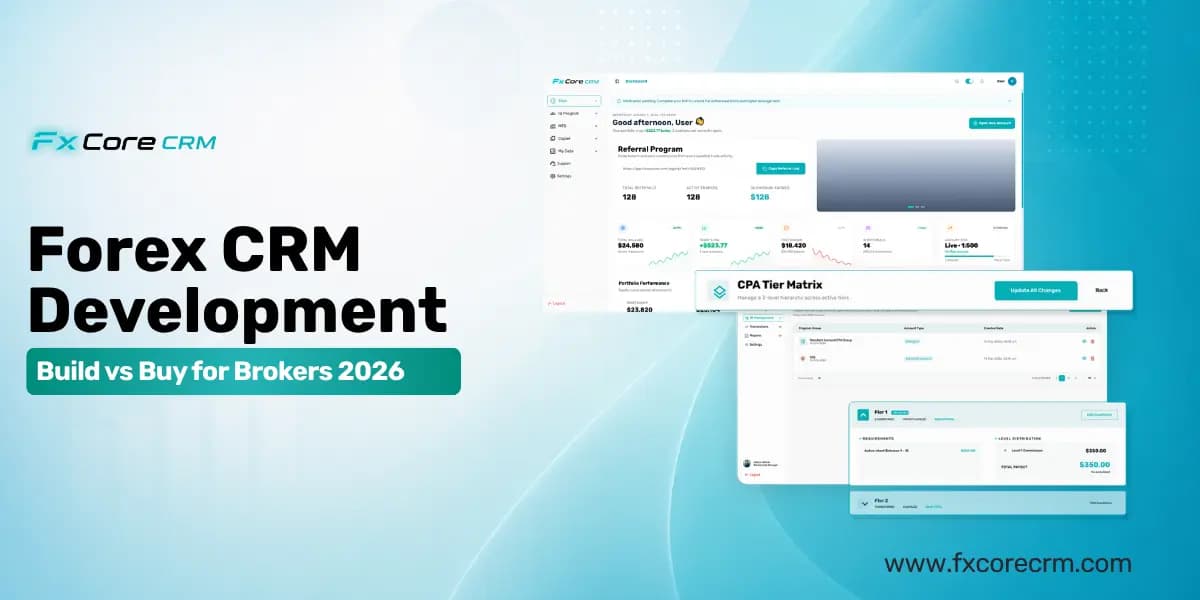
FxCore CRM provides a complete ready-made forex CRM solution that covers every operational requirement of a forex brokerage — without the development cost, timeline risk or ongoing maintenance burden of building from scratch.
What FxCore CRM delivers from week six of implementation:
Native real-time MT5 and MT4 integration handling account provisioning, deposit automation and KYC access control automatically. Unlimited-tier IB management with automated commission calculation from live MT5 trade data — tested across 250+ active broker deployments. Digital KYC onboarding with automated AML screening and compliance queue management producing regulatory-grade audit trails. 100+ payment gateway integrations with automatic MT5 balance credit on payment confirmation. Full white-label client portal on the broker's own domain. Copy trading and PAMM modules. Contest manager for prop trading challenge management. Real-time business intelligence reporting.
The numbers:
- 250+ active forex broker clients globally
- 370+ total integrations
- 340+ successfully delivered projects
- Dubai, UAE headquarters
- 24/7 technical support
Implementation timeline: Four to six weeks to full operational deployment
vs custom development: Twelve to twenty-four months to first live client
Request a free demonstration at https://fxcorecrm.com/request-demo
Contact: [email protected] | WhatsApp: +971 5557 14507
Frequently Asked Questions
Q: How much does it cost to build a forex CRM from scratch?
Building a production-quality forex CRM from scratch typically costs between $210,000 and $550,000 in initial development and takes twelve to twenty-four months to deliver a platform ready for live client operations. The five-year total cost including ongoing maintenance, security, infrastructure and feature development typically reaches $1,500,000 to $4,000,000. A ready-made forex CRM solution delivers the same capability in four to six weeks at a fraction of this cost.
Q: Should a new forex broker build or buy a forex CRM?
For the overwhelming majority of new forex brokerages, buying a ready-made forex CRM solution is the correct decision. The development cost and timeline of building from scratch — twelve to twenty-four months and $210,000 to $550,000 — delays market entry significantly and consumes capital that would generate far better returns invested in client acquisition and IB relationships. Building makes sense only for brokers with genuinely unique operational requirements that no existing platform can support.
Q: Can a forex broker build MT5 integration themselves?
Technically yes — the MetaQuotes Manager API is documented and available to licensed MT5 brokers. In practice, building a production-grade bidirectional real-time MT5 integration requires deep specialist knowledge of the MetaQuotes API, significant development resource and extensive testing. It typically costs $60,000 to $150,000 and takes four to eight months with the right development team. Most ready-made forex CRM solutions include this integration as a standard component that has already been built and tested across hundreds of live broker deployments.
Q: What are the risks of building a custom forex CRM?
The main risks of building a custom forex CRM include timeline overrun — most projects of this complexity take longer than estimated, delaying market entry. Technical failures in the MT5 integration that only surface in production. IB commission calculation errors discovered by IBs during reconciliation. Compliance audit trail inadequacy discovered during regulatory examination. Security vulnerabilities exposing client financial and personal data. These risks are significantly more severe than the risks associated with using a ready-made solution.
Q: How long does it take to implement a ready-made forex CRM?
A standard ready-made forex CRM implementation including MT5 integration, payment gateway connections, KYC workflow configuration, IB structure setup and team training typically completes within four to six weeks. FxCore CRM provides dedicated implementation management throughout the process. Contact [email protected] to discuss the implementation timeline for your specific brokerage requirements.
Q: What is included in a ready-made forex CRM solution?
A complete ready-made forex CRM solution includes native MT5 and MT4 integration, multi-tier IB management with automated commission calculation, digital KYC onboarding with AML screening, payment gateway integrations with automatic MT5 balance credit, white-label client portal and business intelligence reporting — all maintained and updated by the provider as part of the monthly license. FxCore CRM includes all of these components plus copy trading, PAMM and contest manager functionality.
Q: Is it cheaper to build or buy a forex CRM?
Buying is significantly cheaper in almost every realistic scenario. A ready-made forex CRM solution costs $300 to $3,000 per month and deploys in four to six weeks. Building from scratch costs $210,000 to $550,000 in initial development, takes twelve to twenty-four months and requires $8,000 to $25,000 per month in ongoing maintenance. The five-year total cost of building is typically five to ten times the five-year cost of buying a quality ready-made solution.