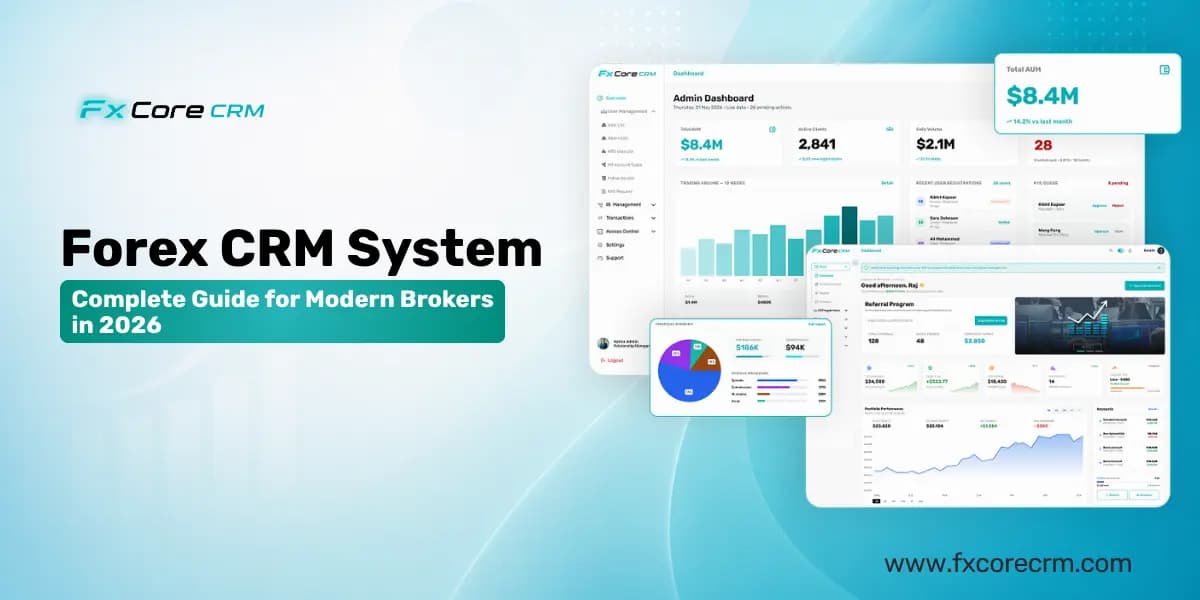
Forex CRM System — Complete Guide for Modern Brokers in 2026
A forex CRM system is the operational core of every successful forex brokerage in 2026. It is the technology platform that connects every moving part of a brokerage operation — client management, trading platform integration, compliance workflows, IB network management, payment processing and business reporting — into one unified system that the entire operations team works from daily.
Without a properly implemented forex CRM system, forex brokers manage these functions across disconnected tools — spreadsheets for IB commissions, email for KYC document collection, manual MT5 admin panel access for account management and generic software for client communication. This fragmented approach fails at scale, generating errors, delays and compliance gaps that compound into serious operational and regulatory problems as client volumes grow.
In 2026 the forex CRM system market has matured significantly. The $530 million market is projected to reach $950 million by 2033, driven by increasing broker demand for unified operational platforms that automate the manual work of running a brokerage at competitive scale. This guide covers everything forex brokers need to understand about forex CRM systems — how they work, what they must include, how to evaluate them and how to implement one that genuinely transforms brokerage operations.
Table of Contents
- What is a Forex CRM System?
- How a Forex CRM System Works
- Core Components of a Forex CRM System
- Forex CRM System vs Generic CRM
- MT5 Integration in a Forex CRM System
- IB Management System
- KYC and Compliance System
- Payment Processing System
- Client Portal System
- Reporting and Analytics System
- How to Choose a Forex CRM System
- Top Forex CRM Systems in 2026
- FxCore CRM System Overview
- Implementation Guide
- Frequently Asked Questions
What is a Forex CRM System?
A forex CRM system is a specialized software platform designed specifically for the operational requirements of forex brokers, prop trading firms and CFD brokers. It combines customer relationship management functions with the forex-specific operational infrastructure that generic CRM tools cannot provide — including direct integration with MetaTrader 5 and MT4 trading platforms, automated KYC and AML compliance workflows, multi-tier IB commission management and payment gateway connectivity.
The term "forex CRM system" encompasses the complete operational technology layer of a forex brokerage — not just the client database component that the word "CRM" might imply in a general business context. A properly specified forex CRM system manages every client interaction and operational process from the moment a lead registers on the broker's website through the complete client lifecycle including account funding, live trading activity, compliance management, support interactions and IB commission attribution.
The scope of a forex CRM system in 2026:
A modern forex CRM system is better understood as a forex brokerage operating system rather than simply a customer database. It integrates and automates:
Client acquisition layer — Lead capture from marketing channels, lead routing to sales teams, follow-up sequence management and conversion tracking from initial inquiry to funded account.
Onboarding layer — Registration workflow management, KYC document collection, identity verification, AML screening, compliance approval workflow and MT5 account provisioning.
Trading operations layer — Real-time MT5 or MT4 data synchronization, account management, deposit and withdrawal processing, margin monitoring and trading condition management.
Partner management layer — Multi-tier IB and affiliate network management, automated commission calculation, partner portal management and payout processing.
Compliance layer — Ongoing KYC monitoring, document expiry tracking, transaction monitoring, regulatory reporting and audit trail maintenance.
Business intelligence layer — Operational reporting, financial analytics, client activity analysis, IB network performance monitoring and management dashboards.
Understanding the full scope of what a forex CRM system covers helps brokers evaluate platforms against their actual operational requirements rather than comparing surface-level feature lists.
How a Forex CRM System Works
A forex CRM system works by creating a central data and workflow hub that connects all the separate systems a forex brokerage relies on — the trading platform, payment gateways, KYC providers, communication tools and client-facing portals — and automating the workflows that move data and trigger actions between these systems.
The Core Operational Flow
Step 1 — Lead to Registration:
A potential client clicks a referral link from an introducing broker's promotion. The forex CRM system captures the lead with full IB attribution recorded at the first touchpoint. The prospect completes a registration form on the broker's website. The CRM system creates a client record, assigns the IB attribution, routes the lead to the appropriate sales team member based on geography and account type, and triggers an automated welcome email sequence.
Step 2 — Registration to KYC:
The registered client receives an automated prompt to complete KYC verification through the branded client portal. The CRM system presents the correct document requirements based on the client's country of residence and account type. The client uploads their identity document and proof of address. The CRM system routes the submission to the compliance team review queue and simultaneously triggers an automated AML screening check against current sanctions lists.
Step 3 — KYC to Funded Account:
The compliance officer reviews the submitted documents in the CRM system's compliance queue and approves the client. The CRM system immediately triggers MT5 account creation with the correct group, leverage and currency settings for the client's account type. The client receives an automated notification with their trading account credentials. The CRM system updates the IB's referral dashboard to show a new approved client in their network.
Step 4 — Funding:
The client logs into the branded client portal and initiates a deposit. The CRM system presents payment methods configured for the client's geographic location. The client completes payment through the integrated gateway. The payment gateway sends a confirmation webhook to the CRM system. The CRM system automatically credits the client's MT5 account balance within seconds. The client can now trade.
Step 5 — Ongoing Operations:
The client's MT5 trading activity synchronizes continuously to the CRM system. IB commission calculations run automatically from the trade data on the configured schedule. The IB sees their commission accumulating in real time in the partner portal. The compliance team monitors account activity through the CRM's compliance dashboard. The operations team handles support queries with full client history visible in the CRM. Management reviews the business intelligence dashboard showing acquisition, revenue and operational metrics.
This complete operational flow — from first marketing touchpoint through ongoing client relationship management — runs within the forex CRM system with minimal manual intervention at each stage.
Core Components of a Forex CRM System
A complete forex CRM system consists of six core components that work together to manage the full brokerage operation:
Component 1 — Client Management System
The client management component is the central database and workflow tool that operations teams use daily:
Client database — Complete client records combining personal information, account details, KYC status, communication history, trading activity summary and support ticket records in a single unified view.
Lead management — Lead capture, scoring, assignment and nurturing workflows converting prospects to registered and funded clients with full conversion funnel analytics.
Segmentation tools — Client categorization by account type, trading volume, geographic market, acquisition source and value segment enabling differentiated treatment and communication.
Communication management — Client communication history across email, SMS, WhatsApp, phone and chat channels maintained in the CRM with full context for every team member handling the client.
Retention tools — Inactivity detection, deposit prompts, reactivation campaigns and churn prediction tools maintaining client engagement and reducing attrition.
Component 2 — Trading Platform Integration System
The trading platform integration component connects the CRM to MT5 or MT4 servers:
Real-time data sync — Continuous synchronization of account balances, equity, open positions, margin levels and trade history from the trading server to the CRM without batch delays.
Account lifecycle management — Account creation, modification and closure managed from the CRM with changes applying to the trading platform automatically.
Access control — KYC status, compliance flags and account restrictions in the CRM applying to trading platform access automatically without separate platform admin actions.
Multi-platform support — Simultaneous integration with multiple trading platforms — MT5, MT4, cTrader, Match-Trader — for brokers running multiple platform environments.
Component 3 — IB Management System
The IB management component handles partner network administration:
Tier structure management — Unlimited depth IB hierarchy configuration with clear tier relationship mapping and performance visibility at every level.
Commission engine — Automated commission calculation running from live MT5 trade data across multiple commission types simultaneously with configurable calculation schedules.
Partner portal — Self-service IB interface showing referred client performance, commission accumulation, payout history and referral link management.
Attribution tracking — Reliable client attribution to IBs from first registration through complete lifecycle ensuring commission integrity.
Payout management — Commission payout request workflow with approval controls and payment processing integration.
Component 4 — Compliance System
The compliance component manages KYC and regulatory requirements:
Document management — Digital document collection, storage, organization and retrieval with document type configuration by client category and jurisdiction.
Verification workflow — Compliance team review queue with assignment, priority management, approval and rejection workflows.
AML screening — Automated sanctions list and PEP database screening at onboarding and on an ongoing basis.
Audit trail — Immutable record of every compliance action with operator identification, timestamp and outcome documentation.
Regulatory reporting — Report generation supporting regulatory submission requirements for the broker's licensing jurisdiction.
Component 5 — Payment System
The payment component handles all financial transaction processing:
Gateway connectivity — Integration with the payment service providers configured for the broker's client markets.
Deposit automation — Payment confirmation triggering automatic MT5 balance credit without manual intervention.
Withdrawal workflow — Withdrawal request management with compliance checking and approval workflow before payment execution.
Reconciliation — Automated matching of payment gateway records against CRM transaction records and MT5 balance changes.
Financial reporting — Transaction volume reporting, fee tracking and financial analytics for management and accounting.
Component 6 — Business Intelligence System
The reporting component provides management visibility and decision support:
Operational dashboards — Real-time overview of key operational metrics — new registrations, KYC completions, deposits, withdrawals and active trading accounts.
Financial reports — Revenue analysis, payment processing volumes, IB commission liability and net revenue reporting.
Client analytics — Acquisition funnel analysis, client lifetime value, churn rates and geographic performance.
IB network reports — Partner performance comparison, commission cost analysis and network growth tracking.
Compliance reports — KYC completion rates, outstanding compliance items and regulatory submission data.
Forex CRM System vs Generic CRM
The most common mistake new forex brokers make is attempting to use a generic CRM tool — Salesforce, HubSpot, Zoho or similar — for forex brokerage operations. Understanding exactly why this fails clarifies why forex-specific CRM systems exist as a distinct product category.
What Generic CRM Tools Provide
✅ Contact database management
✅ Sales pipeline tracking
✅ Email marketing integration
✅ Activity logging
✅ Basic reporting
✅ Third-party integrations via API or Zapier
What Generic CRM Tools Cannot Provide
❌ Native MT5 or MT4 integration (No generic CRM connects to trading servers natively)
❌ Real-time trading account balance visibility (Would require custom API development costing $50,000+)
❌ Forex-specific KYC workflow (No document type configuration, compliance queue management or AML screening integration)
❌ Multi-tier IB commission calculation from trade data (Would require custom development that is prohibitively expensive)
❌ Automated deposit to MT5 balance credit (Payment gateway to trading platform automation impossible without significant custom work)
❌ Forex-specific compliance audit trail (Regulatory examination requirements not met by generic CRM logging)
The Cost of Attempting Generic CRM for Forex
Brokers who attempt to build forex brokerage operations on a generic CRM consistently encounter the same outcome — a growing list of custom development requirements that each individually seem manageable but collectively create a complex, fragile and expensive system that still does not match the capability of a purpose-built forex CRM system.
The development cost of building what a forex CRM system provides out of the box on a generic CRM foundation typically exceeds $200,000-$500,000 in custom development — plus ongoing maintenance costs and the operational risk of a custom-built system without dedicated forex expertise behind it.
In 2026 there is no operational or financial justification for attempting to use a generic CRM for forex brokerage operations.
MT5 Integration in a Forex CRM System
MT5 integration is the technical foundation that determines whether a forex CRM system is genuinely useful for brokerage operations or simply a sophisticated contact database. The quality of MT5 integration separates forex CRM systems that transform brokerage operations from those that simply add another tool to the broker's operational stack.
What MT5 Integration Must Deliver
Real-time bidirectional data sync:
The CRM system must maintain a live, continuous connection to the MT5 server — not a scheduled batch export. Account balances must update within seconds of MT5 changes. Open position data must be current. Trade history must import as trades close. Any sync latency greater than 60 seconds creates discrepancies between what clients see in their portal and what exists on the trading server.
Automatic account provisioning:
When a compliance officer approves a new client in the CRM system, the MT5 account must create automatically with the correct configuration — account group matching the client category, leverage appropriate for the client's regulatory classification, currency matching the client's base currency. The operations team must never need to open the MT5 admin panel to create routine client accounts.
Deposit automation:
Payment gateway confirmation must trigger automatic MT5 balance credit without a manual step. The sequence is: client deposits → gateway confirms → CRM receives webhook → MT5 balance updates. No human action required between payment confirmation and account credit. This automation is not a convenience — it is an operational necessity at any meaningful deposit volume.
KYC access control:
KYC status changes in the CRM system must applyMT5 account access restrictions automatically. Approving a new client activates their MT5 account. Suspending a client for compliance reasons restricts their MT5 access. These controls must be bidirectional and immediate — not requiring separate MT5 admin panel actions that operations team members forget to complete.
Trade data for IB calculations:
MT5 trade history must flow to the CRM system's IB commission engine continuously. Commission calculation must run from actual MT5 trade data — not from manually exported reports — with full traceability from commission amounts back to the specific trades that generated them.
Evaluating MT5 Integration Quality
When evaluating forex CRM systems specifically verify:
□ Is sync real-time or batch? (Batch = significant limitation)
□ Does account creation happen automatically from CRM? (Manual MT5 step = unacceptable)
□ Does deposit credit happen automatically? (Manual credit = unacceptable at scale)
□ Does KYC status automatically control MT5 access? (Manual enforcement = compliance risk)
□ Does trade data flow to commission calculation automatically? (Manual export = error risk)
□ What happens when MT5 connection drops? (Monitoring and alerting = essential)
□ Does the system support multiple MT5 servers? (Important for growing operations)
❌ White-label client portal integrated with MT5 (Building this on a generic CRM requires a development project costing hundreds of thousands)
IB Management System
The IB management system within a forex CRM is the component that manages the introducing broker and affiliate partner networks that drive client acquisition for most retail forex brokerages.
Why IB Management is Critical
For most retail forex brokers, introducing brokers and affiliate partners are the primary client acquisition channel. A master IB managing a regional network of sub-IBs can refer hundreds or thousands of clients over their relationship lifetime with a broker. Losing a top IB to a competitor — typically because of commission errors, payment delays or poor visibility tools — can cost a broker a significant portion of their active client base.
The IB management system within a forex CRM directly determines the quality of the broker's IB relationships and therefore the health of their primary client acquisition channel.
Core IB System Requirements
Unlimited tier architecture:
Real-world IB networks — particularly in Middle Eastern, Indian and Southeast Asian markets — regularly operate five to seven tiers deep. An IB management system limited to two or three tiers cannot serve these markets without manual workarounds that introduce errors and create reconciliation problems at every commission calculation cycle.
Multi-type commission engine:
A single IB network commonly includes IBs operating on different commission arrangements — master IBs on revenue share, regional IBs on spread-based commissions, local IBs on lot-based fees and online affiliates on CPA arrangements. The commission engine must calculate all of these simultaneously from the same MT5 trade data, applying the correct commission type to each IB relationship.
Real-time commission visibility:
IBs who can see their commission accumulating in real time as their referred clients trade are significantly more engaged and more likely to actively promote the broker's services than IBs who receive monthly statements with no intermediate visibility. Real-time commission tracking in the IB portal is not a luxury — it is a retention tool for your most important business partners.
Trade-level commission traceability:
When an IB disputes their commission calculation — which happens in every IB network at some frequency — the CRM system must be able to show exactly which trades generated which commission amounts. Commission calculations that cannot be traced to individual trade level are impossible to audit transparently, creating disputes that damage IB relationships even when the calculation is technically correct.
Automated payout processing:
Commission payouts processed manually — generating payment orders, initiating bank transfers or cryptocurrency payments one by one — become a full-time operational burden as the IB network scales. The IB management system must support automated payout processing triggered by the CRM's approval workflow.
KYC and Compliance System
The compliance system within a forex CRM handles the regulatory requirements that every licensed forex brokerage must meet — from initial client identity verification through ongoing monitoring and regulatory reporting.
Modern KYC System Requirements
Digital document collection:
The compliance system must provide clients with a clear, guided digital document submission interface through the branded client portal. Clients must understand exactly which documents are required, in what format and why — reducing submission errors and accelerating verification.
Intelligent compliance queue:
Submitted KYC documents must route to a structured compliance queue with assignment capability, priority management and status tracking. No document should sit unreviewed because it arrived in a general inbox rather than a managed workflow system.
Automated AML screening:
AML screening must run automatically on all new clients against current sanctions lists and PEP databases — not as a manual step that compliance officers complete when they remember to. Automated screening that runs at submission and flags matches for human review is the operationally and regulatorily correct approach.
Multi-jurisdiction configuration:
Forex brokers serving global client bases apply different KYC requirements to clients in different jurisdictions. UK FCA clients require different documentation than UAE clients, who have different requirements from Indian clients. The compliance system must support jurisdiction-specific document requirement configuration rather than applying a single global standard.
Audit trail integrity:
Regulatory examination of compliance operations evaluates the completeness and integrity of the compliance audit trail. Every document submission, review action, screening result and status change must be recorded with timestamp and operator identification in an immutable log that cannot be edited retroactively.
Document expiry management:
Client documents expire — passports, utility bills and other proof documents have validity periods that differ by document type and jurisdiction. The compliance system must track expiry dates and trigger automated renewal requests before documents expire, maintaining continuous compliance without manual tracking.
Payment Processing System
The payment processing system within a forex CRM connects client deposit and withdrawal activity to MT5 account balances and the broker's payment gateway infrastructure.
Critical Payment System Capabilities
Broad gateway coverage:
A forex CRM payment system with limited gateway coverage forces brokers to turn away clients who cannot use the available payment methods or to manage multiple separate payment systems outside the CRM. A payment system integrated with 100+ gateways covers the full spectrum of payment methods across all major broker markets.
Deposit-to-MT5 automation:
The most important payment system capability is automatic MT5 balance credit on deposit confirmation. Every manual step between payment gateway confirmation and MT5 account credit is a point of failure, delay and client frustration. Automation is not optional — it is the baseline requirement for any viable payment processing implementation.
Compliance-checked withdrawals:
Withdrawal requests must pass through compliance verification before payment execution. Same-method verification, balance availability confirmation, AML-triggered enhanced review for large amounts and approval workflow management must all be built into the withdrawal processing flow rather than handled through separate manual checks.
Multi-currency handling:
Brokers serving global client bases receive deposits in multiple currencies. The payment system must handle currency conversion correctly, maintain accurate records of deposit amounts in both payment currency and account base currency, and report correctly in the broker's reporting currency.
Real-time reconciliation:
Payment gateway records, CRM transaction records and MT5 balance changes must reconcile automatically with discrepancy alerts for mismatches. Reconciliation that runs only during monthly accounting processes allows errors to compound over weeks before detection.
Client Portal System
The client portal — also known as the trader room — is the client-facing component of the forex CRM system. It is what clients interact with daily for account management, funding and support.
Client Portal System Essentials
Real-time MT5 account display:
Clients must see their actual current MT5 account balance, equity, open positions and margin level in real time. Portfolio displays that show yesterday's data or require manual refresh destroy client confidence in the broker's platform quality.
Complete deposit and withdrawal management:
The entire deposit and withdrawal process must be manageable from the client portal without requiring clients to contact support for routine financial transactions. Payment method selection, amount entry, gateway routing, status tracking and history display all within the portal.
KYC management:
Clients must be able to check their KYC status, see which documents are required, upload documents and track verification progress entirely through the portal. Email-based KYC document collection creates a disorganized, slow process that damages the onboarding experience.
Multi-account management:
Clients with multiple trading accounts — standard, VIP, Islamic, demo — must manage all accounts from a single portal login with clear account identification and separate financial management per account.
Mobile optimization:
In 2026 the majority of forex clients access their broker portal on mobile devices. A client portal that is not fully functional on mobile — not merely readable but fully operational including deposits, withdrawals and account management — is not competitive.
Reporting and Analytics System
The business intelligence component of a forex CRM system provides the management visibility needed to make informed decisions about brokerage growth, operational efficiency and commercial performance.
Essential Reporting Capabilities
Client acquisition funnel:
Registration to KYC completion to first deposit to first trade — conversion rates at each stage reveal where the onboarding process loses potential clients and where optimization will have the greatest revenue impact.
Revenue analytics:
Trading volume by instrument, spread revenue estimation, fee income by product and net revenue by client segment provide the financial intelligence needed for pricing optimization and product development decisions.
IB network performance:
Comparative IB performance showing referred client volumes, trading activity and commission cost per client identifies the most commercially valuable IB relationships and informs IB incentive program design.
Operational efficiency metrics:
KYC completion times, support resolution rates, deposit processing times and withdrawal queue lengths provide the operational performance data needed to manage the brokerage team effectively and identify process bottlenecks before they impact client experience.
Compliance reporting:
KYC completion rates, outstanding compliance items, document expiry approaching and suspicious activity flags give the compliance team the visibility needed to manage regulatory requirements proactively.
How to Choose a Forex CRM System
Step 1 — Define Your Requirements Specifically
- □ Trading platform: MT5, MT4, cTrader, or multiple platforms?
- □ Client base geography and preferred payment methods?
- □ IB network: existing size, tier depth, and commission types?
- □ Regulatory jurisdiction and KYC requirements specific to your license?
- □ Expected client volume in Year 1 and Year 3?
- □ Team size using the back office?
- □ White label requirement?
- □ Required implementation timeline?
- □ Monthly budget for the platform?
Step 2 — Evaluate MT5 Integration Quality
- □ Request a live demo of account creation timing from CRM to MT5 provisioning.
- □ Request a live demonstration of deposit processing from the client portal to MT5 balance credit.
- □ Ask about synchronization latency—measured in seconds, not minutes.
- □ Ask about integration monitoring and failure alerting.
- □ Verify multi-server support if you operate multiple MT5 servers.
Step 3 — Evaluate IB System Capability
- □ Request a demo configured with your actual IB tier structure.
- □ Run commission calculations using sample trade data.
- □ Verify that all commission types you use are supported.
- □ Review the IB portal from a partner's perspective.
- □ Test sub-IB visibility for master IB accounts.
Step 4 — Assess Total Cost of Ownership
- □ Setup and implementation fee.
- □ Monthly platform license fee.
- □ Per-client fees at your projected volume.
- □ Gateway integration costs.
- □ Support tier costs.
- □ Contract length and exit terms.
- □ Price escalation clauses.
Step 5 — Check Provider Stability
- □ How many active broker clients do they have?
- □ How long have they been in the forex CRM market?
- □ What support availability do they provide?
- □ What uptime SLA do they offer?
- □ Can they provide customer references?
Top Forex CRM Systems in 2026
1. FxCore CRM — Best for MT5 Brokers and Dubai Operations
FxCore CRM provides a complete forex CRM system for MT5 and MT4 brokers with native real-time integration, unlimited-tier IB management, automated KYC onboarding, 100+ payment gateway connectivity and white-label client portal — serving 250+ active broker clients globally from Dubai headquarters.
Best for: MT5 brokers, Dubai and Middle East operations, new and growing brokerages, prop trading firms
Website: https://fxcorecrm.com
2. AltimaCRM — Best for Sales-Heavy Operations
AltimaCRM focuses on sales operations with built-in VoIP and AI-powered compliance. 18+ years in fintech and Finance Magnates recognition.
Best for: Established brokers with large sales teams
3. Syntellicore — Best for Compliance-First Brokers
Syntellicore provides deep compliance automation with native mobile application. CySEC-focused withBest Forex CRM 2026 award recognition.
Best for: CySEC and FCA regulated brokers
4. B2Core — Best for Enterprise Operations
B2Core is the enterprise-grade CRM component of B2Broker's technology ecosystem, suited to large multi-asset brokerages.
Best for: Large enterprise-scale operations
5. UpTrader — Best for Copy Trading and Prop Firms
UpTrader specializes in copy trading infrastructure and flexible commission structures for diverse brokerage models.
Best for: Prop trading firms and copy trading focused brokers
FxCore CRM System — Complete Overview
FxCore CRM provides a complete forex CRM system built specifically for MT5 and MT4 brokers — integrating all six core components into one unified platform:
Client Management System:
Complete client lifecycle management from lead capture through onboarding, account management, retention and compliance — all within a single CRM interface used by your entire operations team.
MT5 Integration System:
Native real-time bidirectional MT5 and MT4 integration providing automatic account provisioning, real-time balance sync, automated deposit credit, KYC-triggered access control and trade data import for IB commission calculation.
IB Management System:
Multi-tier IB management supporting unlimited tier depth with automated commission calculation from MT5 trade data across spread-based, lot-based, volume-based and CPA commission structures simultaneously. Dedicated IB partner portal with real-time performance dashboards.
KYC and Compliance System:
Digital document collection through branded client portal, compliance team review queue management, automated AML screening, KYC-triggered MT5 account activation and complete regulatory audit trail generation.
Payment Processing System:
100+ payment gateway integrations covering international, regional and cryptocurrency payment methods. Automatic MT5 balance credit on deposit confirmation. Compliance-checked withdrawal processing with approval workflow.
Business Intelligence System:
Operational dashboards, financial analytics, client acquisition funnel reporting, IB network performance analysis and compliance reporting combining MT5 trading data with operational metrics.
Platform statistics:
- 250+ active forex broker clients globally
- 370+ total integrations
- 340+ successfully delivered projects
- Brokers across Middle East, Europe and Asia
- Dubai, UAE headquarters
- 24/7 technical support
Request a FxCore CRM system demo:
https://fxcorecrm.com/request-demo
Implementation Guide
Phase 1 — Planning (Week 1–2)
- □ Document current operational workflows and identify gaps.
- □ Define MT5 account group structure for client categories.
- □ Document IB commission structures for all IB relationships.
- □ Define KYC workflow requirements for your licensing jurisdiction.
- □ Identify payment gateways needed for your client markets.
- □ Map existing client data for migration (if applicable).
- □ Define user roles and access permissions for your team.
- □ Set up a test MT5 server for integration testing.
Phase 2 — Configuration (Week 3–4)
- □ Configure MT5 integration with the test server.
- □ Set up account groups and test the account creation workflow.
- □ Configure IB tier structures and commission rules.
- □ Set up the KYC workflow with document type requirements.
- □ Integrate the first payment gateways and test deposit processing.
- □ Configure the client portal with brand customization.
- □ Set up team user accounts with appropriate permissions.
- □ Configure automated notifications and workflow triggers.
Phase 3 — Testing (Week 5)
- □ Test the complete client onboarding workflow end to end.
- □ Test deposit processing from the client portal through to MT5 balance credit.
- □ Test IB commission calculations against sample trade data.
- □ Test the KYC workflow, including document submission and approval.
- □ Test MT5 account activation triggered by KYC approval.
- □ Test all automated notifications.
- □ Complete user acceptance testing (UAT) with the full operations team.
Phase 4 — Go-Live (Week 6)
- □ Switch to the production MT5 server.
- □ Migrate existing client data.
- □ Train all team members.
- □ Enable the client portal for existing clients.
- □ Monitor integration health intensively during the first 48 hours.
- □ Perform daily reconciliation checks during the first week after launch.
Frequently Asked Questions
Q: What is a forex CRM system?
A forex CRM system is a specialized software platform that manages the complete operational requirements of a forex brokerage — combining client management, MT5 or MT4 trading platform integration, KYC compliance workflows, IB commission management, payment processing and business reporting in one unified system. It is the operational core of a modern forex brokerage, connecting all the separate systems and automating the workflows that make brokerage operations viable at scale.
Q: How is a forex CRM system different from a generic CRM?
A forex CRM system provides native MT5 and MT4 trading platform integration, forex-specific KYC and compliance workflows, multi-tier IB commission management and payment gateway connectivity to trading account balance automation. Generic CRM tools like Salesforce or HubSpot cannot provide any of these capabilities without extensive and expensive custom development. In 2026 no operational or financial justification exists for attempting to run a forex brokerage on a generic CRM platform.
Q: What does a forex CRM system cost?
Forex CRM system pricing ranges from $300 per month for entry-level configurations to $3,000+ per month for enterprise deployments. Setup fees, per-client fees, integration costs and support tier selection all contribute to the total monthly cost. Calculate the true all-in cost at your projected client volumes rather than comparing only base license fees. Contact FxCore CRM at [email protected] for pricing specific to your brokerage configuration and requirements.
Q: How long does it take to implement a forex CRM system?
A standard forex CRM system implementation including MT5 integration, payment gateway connections, KYC workflow configuration, IB structure setup and team training typically completes within four to six weeks. More complex implementations involving multiple MT5 servers, multi-brand configurations or large client data migrations may require additional time. FxCore CRM provides dedicated implementation management throughout the go-live process.
Q: Does a forex CRM system need to integrate with MT5 in real time?
Yes. Real-time MT5 integration is essential for viable forex brokerage operations. Batch synchronization that updates account data hourly or daily creates discrepancies between what clients see in their portal and their actual trading account status, generates errors in IB commission calculations and prevents deposit automation. Any forex CRM system using batch sync rather than real-time integration is operationally unsuitable for a live brokerage.
Q: Can a forex CRM system handle multiple MT5 servers?
Yes — quality forex CRM systems including FxCore CRM support simultaneous integration with multiple MT5 servers within a single CRM instance. Multi-server support is important for brokers who separate client segments across different MT5 servers, run demo and live trading on separate servers, or operate across multiple geographic regions with regional server infrastructure.
Q: What IB management capabilities must a forex CRM system include?
A forex CRM system must support unlimited IB tier depth for complex multi-tier networks, automated commission calculation from MT5 trade data without manual export, multiple simultaneous commission types including spread-based, lot-based and CPA arrangements, real-time IB performance dashboards in dedicated partner portals, commission traceability to individual trade level for dispute resolution and automated payout processing with approval workflow management.
Q: Is FxCore CRM a complete forex CRM system?
Yes. FxCore CRM provides all six core components of a complete forex CRM system — client management, MT5 integration, IB management, KYC compliance, payment processing and business intelligence — in one unified platform serving 250+ active forex broker clients globally. Request a demo at fxcorecrm.com/request-demo to see the complete system configured for your specific brokerage requirements.
Q: What is the best forex CRM system in 2026?
The best forex CRM system in 2026 depends on your brokerage model, trading platform, geographic market and operational scale. FxCore CRM leads for MT5 brokers,Dubai and Middle East operations and brokerages at all growth stages seeking competitive pricing with comprehensive system capability. AltimaCRM suits sales-heavy established operations. Syntellicore fits compliance-first European regulated brokers. B2Core serves enterprise-scale multi-asset operations. Request demonstrations from each provider specifically configured for your broker requirements before making a final decision.
Conclusion
A forex CRM system is not a software purchase — it is a fundamental infrastructure decision that determines whether a forex brokerage can operate efficiently, scale sustainably and maintain regulatory compliance as client volumes grow.
The six core components that make up a complete forex CRM system — client management, MT5 integration, IB management, KYC compliance, payment processing and business intelligence — work together to replace the disconnected manual processes that limit brokerage growth with automated workflows that scale without proportional increases in operational cost and error risk.
FxCore CRM delivers the complete forex CRM system forex brokers need in 2026 — with native real-time MT5 integration, unlimited-tier IB management, automated KYC onboarding, 100+ payment gateway connectivity and comprehensive business intelligence from a Dubai headquarters serving 250+ active broker clients across Middle East, Europe and Asia.
Request your free forex CRM system demonstration:
Visit https://fxcorecrm.com/request-demo
Email: [email protected]
WhatsApp: +971 5557 14507