Forex CRM System Explained: Architecture and Key Modules
Most brokers choose a CRM by looking at screens. They watch a demo, see a clean dashboard and compare feature lists. But two platforms can look almost identical in a demo and behave very differently once real clients, real deposits and a real IB network are running through them.
The difference is architecture. How the system is built underneath decides how fast data moves, what breaks when one part fails and whether the platform can grow with your brokerage or hits a wall at a few thousand clients.
This guide explains how a forex CRM system is actually put together: the layers, the modules inside them and how data moves between them. You don’t need to be a developer to follow it. The goal is to help you ask better questions before you buy.
What a Forex CRM System Really Is
A forex CRM system is not one application. It is a set of connected services that together run a brokerage’s daily operations. Clients register, verify their identity, get a trading account, deposit money, trade, withdraw, and are tracked by the partners who referred them. Every one of those steps touches a different part of the system.
A generic CRM stores contacts and sales activity. A forex CRM system also has to talk to the trading server, move money through payment gateways, calculate partner commissions from trade data and keep a compliance record regulators will accept. That extra scope is why the architecture matters.
The Layers of a Forex CRM Architecture
It helps to picture the system as five layers stacked on top of each other.
Layer 1: The Trading Platform Layer
At the bottom sits the trading server, usually MT5 or MT4, sometimes cTrader or Match-Trader. This is where accounts live, orders execute and balances change. The CRM does not replace it. It controls and observes it.
Layer 2: The Integration Layer
This is the most important layer and the one most often misunderstood. It is the connection between the CRM and the trading server. In MT5, it is built on the Manager API, a persistent connection that lets the CRM read account data, create accounts, credit balances and receive events as they happen.
If this layer is weak, everything above it is weak. Batch syncing, middleware hops or read-only connections show up as stale balances, slow deposits and manual work for your team. A solid MT5 integration is bidirectional, runs continuously and is monitored for failures.
Layer 3: The Core Services and Data Layer
This layer holds the system’s brain and memory: the client database, account records, transaction ledger, IB hierarchy, commission records and audit logs. Every module reads from and writes to this shared core.
The key architectural question here is whether all modules share one database or whether each module keeps its own copy of the data. Shared data means a client’s KYC status, balance and IB attribution are always consistent. Separate copies mean reconciliation problems.
Layer 4: The Module Layer
This is where the business logic lives: onboarding, payments, partner management, reporting and the other modules covered below. Each module handles one area of operations but depends on the core and integration layers underneath.
Layer 5: The Presentation Layer
What people actually see: the back office used by your staff, the client portal used by traders and the partner portal used by IBs. Three different audiences, three different interfaces, one system underneath.
The Key Modules Inside a Forex CRM
Client and Lead Management
This module handles the whole client lifecycle, from the first registration to long-term retention. It stores profiles, tracks where leads came from, assigns them to team members and records every interaction. In a forex CRM, each client record also shows live trading account data pulled from the trading layer, so support staff don’t need a second login to answer a balance question.
Digital Onboarding and KYC
The digital onboarding module collects identity documents through the portal, runs AML screening, routes submissions to a compliance review queue and records every decision in an audit trail. Its architectural value is what happens next: approval triggers account creation in the trading layer automatically. This is a good example of how modules depend on each other.
Payments and Transactions
This module connects to payment gateways, receives payment confirmations and credits trading accounts. It also manages withdrawal requests through an approval workflow. Every deposit and withdrawal lands in the central ledger so finance can reconcile gateway records against trading balances.
The critical design point is the webhook path. A gateway confirms a payment, the CRM validates it and the integration layer credits the account. Any manual step in that chain is a delay and a risk.
IB and Partner Management
The IB management module stores the partner hierarchy, applies commission rules and calculates what each partner earns from live trade data. In a well-built system it supports unlimited tier depth, several commission types at once and trade-level traceability, so any commission figure can be traced back to the trades behind it.
Because commission depends on trade data, this module relies heavily on the integration layer. A system with batch trade syncing will always calculate commissions on old data.
Client Portal
The client portal is the white-labeled trader room. It sits on your domain and shows real-time account data, handles deposits and withdrawals, accepts KYC uploads and gives access to the trading platform. It is a window into the other modules rather than a separate system, which is why it only feels fast and accurate if the layers beneath it are.
Social Trading Modules
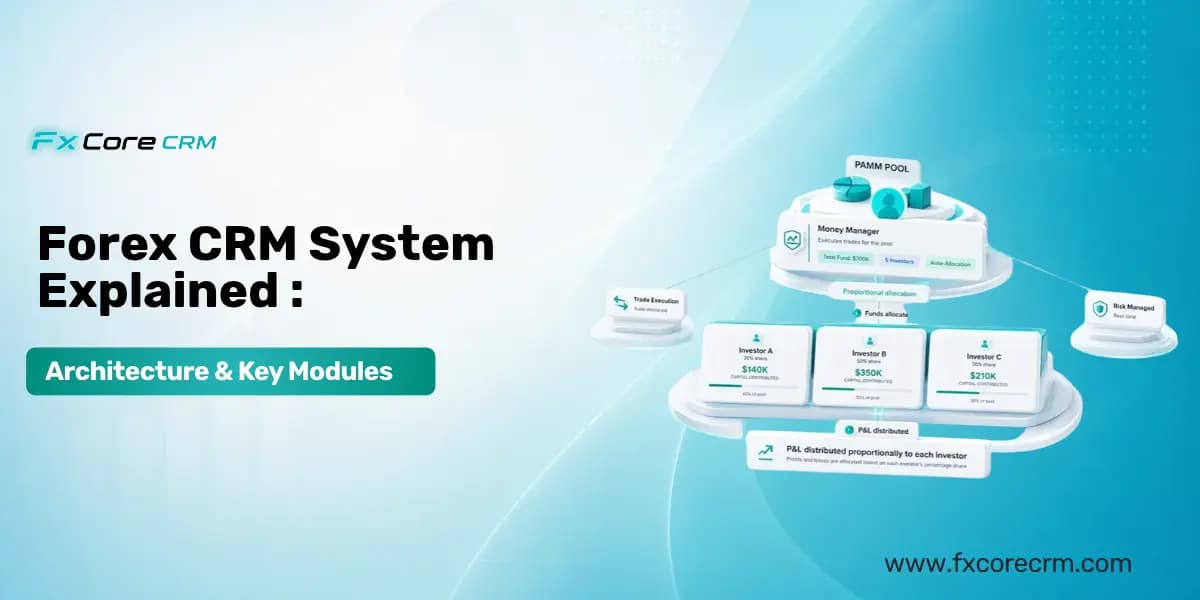
Copy trading and PAMM modules sit on top of the trading layer. Copy trading replicates trades from signal providers to followers. PAMM pools investor capital under a manager and distributes results proportionally. When these are built into the platform, they share the same accounts, ledger and portal as everything else. When they are bolted on from a third party, you end up with duplicate data and extra integrations.
Contest and Challenge Management
For brokers running trading competitions or prop-style challenges, this module tracks participants from trade data, ranks them against configured rules and manages results. Like the social modules, it works because it reads directly from the trading layer.
Communications
Email, WhatsApp and in-platform notifications keep clients and partners informed about deposits, KYC status and withdrawals. The architectural question is whether communications are triggered by system events automatically or sent manually by staff.
Reporting and Analytics
Because data from trading, payments, onboarding and IB activity all sits in one core, reporting can combine it without exports. That is how a dashboard can show registrations, funded accounts, deposits and partner performance together.
Administration and Security
Role-based permissions, activity logs, two-factor authentication and data encryption control who can see and do what. In a system that handles identity documents and client funds, this module is a core part of the architecture rather than an add-on.
How the Modules Work Together: A Client’s Journey
Seeing one client move through the system shows why architecture matters.
A client registers through a partner’s referral link. The client management module records the registration and the IB module records the attribution. The client uploads documents in the portal, and the onboarding module runs AML screening and queues the case. A compliance officer approves it, and the integration layer creates an MT5 account in the correct group.
The client deposits. The gateway confirms, the payments module validates and the integration layer credits the balance. The client trades. Trade data flows back through the integration layer into the core, where the IB module calculates commission for every tier above the client. The partner sees that commission in their portal, and management sees the whole picture in the reporting module.
Eight modules took part in that single journey. If any link is manual or delayed, your team ends up doing the connecting work by hand.
Architecture Questions to Ask Any Vendor
You can learn more from five architecture questions than from a feature checklist.
- How does the system connect to MT5? Ask whether it uses a persistent Manager API connection or middleware, and whether the data sync is real-time or batch.
- Do all modules share one database? Shared data keeps statuses and balances consistent.
- What happens when the trading server connection drops? Look for monitoring, alerts and automatic recovery.
- Are copy trading, PAMM and contests built in or integrated from third parties? Built-in modules share data cleanly.
- Does it support multiple trading servers? Standard and Islamic account servers, or regional servers, should all appear in one interface.
A vendor who answers these clearly and lets you watch them work live understands their own architecture. Vague answers usually mean the architecture is vague.
Scalability and Security Considerations
Two more architecture topics deserve attention before you commit.
On scalability, ask how the system behaves at ten times your current client count. Report speed, commission calculation time and portal responsiveness should not degrade sharply as data grows. Ask for the largest live deployment the vendor supports.
On security, the platform holds identity documents, financial records and trading access. Look for encrypted storage, role-based access, full audit logging, two-factor authentication and a clear policy on how the MT5 manager credentials are limited in permission. Ask where data is hosted and how backups and disaster recovery work.
How FxCore CRM Is Built
FxCore CRM is a Dubai-based platform built for MT5 and MT4 broker operations. Its modules, including client management, onboarding, payments, IB management, client portal, copy trading, PAMM and contest manager, run on a shared core connected to the trading server through a native integration layer. That is what allows account provisioning, deposit credit and commission calculation to run without manual steps in between.
Request a demo and ask to see the architecture questions above answered live, with your own MT5 setup, IB structure and payment methods.
Request a demo: https://fxcorecrm.com/request-demo
Email: [email protected] | WhatsApp: +971 5557 14507
Frequently Asked Questions
Q: What is a forex CRM system?
It is a platform that runs a brokerage’s daily operations by connecting client management, trading server integration, payments, KYC and partner commissions in one system.
Q: What are the main modules of a forex CRM?
Client and lead management, digital onboarding and KYC, payments, IB management, client portal, social trading, reporting and administration.
Q: Why does architecture matter more than features?
Two platforms can share the same feature list but differ in how data syncs, how failures are handled and how well they scale. Architecture decides real-world speed and reliability.
Q: What is the integration layer?
It is the connection between the CRM and the trading server. In MT5 it is built on the Manager API and controls account creation, balance credits and live data sync.
Q: Should all modules share one database?
Yes. A shared core keeps KYC status, balances, transactions and IB attribution consistent across the whole platform.
FxCore CRM is a forex technology provider headquartered in Dubai, UAE. The platform does not provide financial services or investment advice.