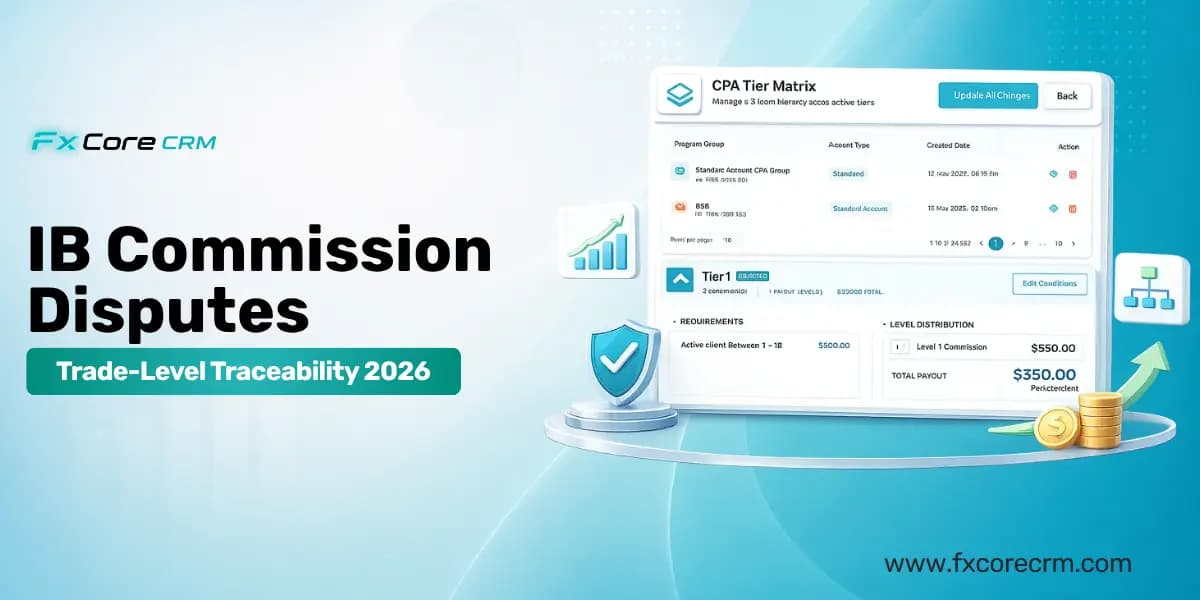
IB Commission Disputes: How Trade-Level Traceability Prevents Them
Every forex broker who manages a significant IB network has experienced an IB commission dispute at some point. The IB contacts the account manager saying their commission statement does not match what they calculated from their own records. The broker's finance team investigates. The investigation takes days. The numbers eventually reconcile — or do not — and the relationship carries some damage regardless of the outcome.
IB commission disputes are not just an operational inconvenience. They are a direct threat to the broker-partner relationships that drive client acquisition. A top IB who has experienced even one significant commission error that was not resolved quickly and transparently begins evaluating other broker relationships — and in forex IB networks where information travels fast through WhatsApp groups and Telegram communities, their opinion of the broker's reliability travels with them.
The good news is that the large majority of IB commission disputes are preventable. Not through better spreadsheet management or more careful manual calculation, but through trade-level traceability — the ability to show any IB exactly which trades generated which commission amounts, down to the individual trade level, at any time.
This guide covers why IB commission disputes happen, what trade-level traceability is, how it prevents disputes from arising and how it resolves them quickly when they do.
Why IB Commission Disputes Happen
Understanding the root causes of IB commission disputes makes it clear why trade-level traceability solves them so effectively.
Manual calculation errors
The most common cause of IB commission disputes is manual calculation error. When IB commissions are calculated from manually exported MT5 trade reports processed through spreadsheets, errors accumulate through the calculation chain — partial exports that miss trades from specific time windows, incorrect date range selection, formula errors in commission calculation logic, rounding differences between calculation methods and human data entry mistakes when figures are transferred between systems.
Each individual error may be small. Across a large IB network with hundreds of IBs and thousands of trades per month, small systematic errors produce noticeable discrepancies that IBs discover when they compare their own estimates against the commission statement they receive.
Timing differences in calculation
Commission calculation that runs at a specific time captures the trade data that exists at that moment. If the calculation runs at midnight on the last day of the month and some trades from that day close after midnight, those trades fall into the next month's calculation — even though the IB considers them part of the current period based on when they were opened.
Different brokers handle this differently. Some calculate on trade open date, others on trade close date. The calculation basis is not always clearly communicated to IBs, who apply their own logic when estimating their commission — creating expectation differences that look like discrepancies even when the broker's calculation is technically correct.
Multi-tier attribution errors
In complex multi-tier IB structures, attribution errors create commission discrepancies that are particularly difficult to trace manually. A client registered through an IB referral link that was incorrectly attributed to the wrong IB generates commission credited to the wrong account. A sub-IB relationship that was not correctly configured at setup means commission flows to the wrong tier level. These errors often go undetected for months before an IB's own analysis identifies a client who has been trading actively but generating no visible commission.
Commission type configuration errors
Brokers who support multiple commission types simultaneously — spread-based commissions for some IBs, lot-based for others, volume-based tiered rates for others — create commission calculation complexity where a configuration error for one IB type can affect commission across that entire IB's network. If a spread-based commission rate was incorrectly entered as 0.2 pips instead of 0.2 points, every trade for every client referred by that IB produces a different commission from what the IB expected.
Currency conversion differences
IBs who earn commission from clients trading in multiple currencies may notice small differences between their own commission estimates and the statements they receive — caused by currency conversion rate differences between when the trade occurred and when the commission was calculated, or by different rounding conventions applied to currency conversion. These differences are typically small individually but accumulate to noticeable amounts across large trading volumes.
What Trade-Level Traceability Means
Trade-level traceability means every commission amount in every IB's statement can be traced directly to the specific MT5 trades that generated it — with the trade ticket number, instrument, volume, commission rate applied and resulting commission amount visible for each individual trade.
This is fundamentally different from statement-level commission reporting, where an IB receives a total commission figure for the period with a breakdown by client but no visibility into which specific trades generated the per-client commission totals.
With trade-level traceability, an IB who disputes a specific commission amount for a specific client can see the complete trade-by-trade breakdown — every trade that client made during the period, the commission generated by each trade and the cumulative total that produced the commission statement figure. If the IB's own calculation produces a different result, they can identify the specific trade where the discrepancy exists rather than disputing an aggregate number that requires days of investigation to audit.
This level of transparency does something important beyond resolving disputes when they arise — it prevents most disputes from arising in the first place. When IBs know they can verify their commission at trade level at any time, they are more likely to trust the system's calculation even in periods where their quick estimate produced a different number.
The Difference Between Statement Transparency and Trade Transparency
There is an important distinction between commission statement transparency and trade-level transparency that many brokers conflate.
Statement transparency means the IB can see their commission broken down by client — showing how much commission each referred client generated in the period. This is better than a single aggregate number but still does not allow the IB to verify how a specific client's commission figure was calculated.
Trade-level transparency means the IB can drill into any client's commission figure and see the individual trades that produced it. This level of transparency completely eliminates the "black box" quality of commission calculation that makes IBs uncomfortable — and that discomfort is often the underlying cause of disputes that arise even when the calculation is technically correct.
An IB who can open their partner portal, click on a client's name and see a list of every trade that client made during the period — with instrument, volume, open and close time, commission rate and individual trade commission — has everything they need to verify the calculation themselves. If their number matches the statement, the conversation ends there. If it does not, they can identify the specific trade creating the discrepancy immediately.
This transforms the dispute from "your commission statement is wrong" to "trade ticket 12345678 shows a commission of $X but I calculate $Y based on the agreed rate for this instrument" — a specific, verifiable claim that resolves in minutes rather than days.
How the IB Management System Enables Trade-Level Traceability
Trade-level traceability in a forex CRM's IB management system requires the commission engine to pull trade data from MT5 at the individual trade level — not aggregated trade summaries but the complete trade record for every closed position.
When the MT5 Manager API connection provides complete trade history, the commission engine can store the full trade record alongside the commission calculation output for every trade. The commission statement then has a complete audit trail behind it — every line item traceable to a specific MT5 trade ticket with the full trade details preserved.
The IB partner portal surfaces this traceability in the client-facing view. Rather than showing only the commission total per client, the portal allows the IB to expand any client's commission figure to see the trade-by-trade breakdown. Each trade shows the MT5 ticket number — which the IB can verify in their own MT5 platform — instrument, volume, open and close time and the commission amount calculated from that trade at the agreed rate.
For the broker's finance team, the same trade-level data enables rapid investigation when a dispute does arise. Instead of requesting MT5 trade reports, combining them with commission calculation records and reconciling the two manually, the finance team member can pull up the complete commission audit trail for any IB, any client and any period immediately from the forex CRM back office.
When Disputes Still Arise: Resolving Them Quickly
Even with trade-level traceability in place, disputes occasionally arise — usually from genuine calculation logic disagreements rather than errors, or from edge cases in commission rules that the configuration did not anticipate.
The difference that trade-level traceability makes in these cases is resolution speed. A dispute that previously required days of manual investigation — exporting MT5 reports, tracing commission calculations through spreadsheet formulas, identifying which specific trades or configuration elements produced the discrepancy — resolves in minutes when every piece of information is already assembled in the commission audit trail.
The typical dispute resolution workflow with trade-level traceability:
An IB contacts their account manager saying their commission for the previous month looks $200 lower than their own estimate for a specific client. The account manager opens that IB's commission record in the back office, navigates to the disputed client and opens the trade-level breakdown. They identify immediately that two specific trades were closed in the first minutes of the following month and therefore fell into the next period's calculation — a timing difference, not an error.
The account manager shares the trade-level breakdown with the IB — showing the specific tickets, their close times and the period they were attributed to. The IB checks those tickets in their own MT5 platform, confirms the close times and understands the calculation basis. The dispute resolves in the same conversation it arose in.
This outcome — rapid, evidence-based resolution that leaves the IB's confidence in the broker's commission system intact — is what trade-level traceability makes possible. The alternative outcome, where the investigation takes days and the IB spends that time uncertain about the reliability of the broker's commission calculation, damages the relationship even when the investigation ultimately confirms the broker's calculation was correct.
Multi-Tier Traceability
In multi-tier IB structures, trade-level traceability needs to work across every tier of the network — not just at the direct IB to client level.
A master IB managing a network that includes regional sub-IBs and local IBs below them needs to be able to see their commission traced to the trades of clients who are multiple levels below them in the network. The commission earned by a master IB from a client referred by one of their sub-IB's sub-IBs should be traceable to the specific trades that client made — even though the master IB may have no direct relationship with that end client.
This multi-tier traceability is more complex to implement than single-tier commission tracking — the commission calculation must correctly traverse the IB hierarchy, apply the correct commission rate at each level and maintain the trade-level attribution through every tier. But it is exactly the transparency that master IBs in complex networks need to verify that their commission income from deep in their network is being calculated correctly.
The IB management module must store the complete attribution chain for every commission-generating trade — which IB at each tier level earned commission from this trade, at what rate and for what amount — so that any IB at any level of the network can verify their commission from their own vantage point in the hierarchy.
IB Portals: Making Traceability Self-Service
The operational efficiency of trade-level traceability multiplies significantly when IBs can access the trade-level detail themselves through their partner portal — without needing to contact the broker's operations team to request commission breakdowns.
An IB partner portal that provides trade-level commission visibility serves three functions simultaneously.
It reduces support volume from commission queries. IBs who can verify their commission independently do not need to contact the broker to ask for commission breakdowns. The queries that remain are genuine disputes rather than information requests, and they arrive pre-investigated — the IB has already reviewed the trade-level detail and identified the specific discrepancy rather than arriving with a general concern that requires substantial investigation before the issue can even be characterized.
It builds IB confidence in the commission system. IBs who regularly check their commission at trade level and consistently find that the calculation matches their own verification become advocates for the broker's commission reliability — the opposite of IBs who never have visibility and periodically suspect they are being underpaid without the evidence to pursue the concern.
It supports IB network growth. IBs who recruit sub-IBs to a broker's network are endorsing that broker's commission reliability to their own contacts. An IB who can show prospective sub-IBs the level of transparency available in the partner portal — including trade-level commission verification — is making a more compelling recruitment case than one who can only describe the commission rates without evidence of how they are calculated and verified.
FxCore CRM IB Commission Traceability
FxCore CRM's IB management system provides trade-level commission traceability as a core component of the commission calculation and reporting architecture — not an optional add-on but a fundamental characteristic of how the commission engine works.
Commission calculations run directly from MT5 trade data pulled through the native Manager API connection — every trade record includes the complete MT5 trade details alongside the commission calculation output. The commission statement for any IB in any period has a complete trade-level audit trail behind every line item.
The IB partner portal surfaces trade-level detail in the self-service interface — IBs can expand any client's commission figure to see the trade-by-trade breakdown without contacting the broker's operations team. The detail shown includes MT5 ticket number, instrument, volume, open and close time, the commission rate applied and the individual trade commission amount.
For the broker's finance team, the same trade-level data is available in the back office commission management interface — enabling rapid investigation when disputes arise without requiring MT5 admin panel access or manual trade report exports.
Multi-tier commission traceability works across all tiers of the IB network — master IBs can trace their commission from deep in their network to specific trades, with the complete attribution chain stored and accessible at every tier level.
The white-label client portal provides clients with their own trade history — so client-side verification of trading activity that underlies IB commission is also accessible, creating end-to-end transparency from the trade level through to the IB commission statement.
Request a demonstration of FxCore CRM's trade-level IB commission traceability at https://fxcorecrm.com/request-demo
Contact: [email protected] | WhatsApp: +971 5557 14507
Frequently Asked Questions
Q: What causes most IB commission disputes in forex brokerages?
Most IB commission disputes are caused by manual calculation errors from spreadsheet-based commission processing, timing differences in how trade close dates are attributed to calculation periods, multi-tier attribution errors where clients are incorrectly assigned to IB relationships and commission type configuration errors affecting specific instrument or account type calculations. Trade-level traceability addresses all of these by making every commission calculation verifiable at the individual trade level.
Q: What is trade-level traceability in IB commission management?
Trade-level traceability means every commission amount in an IB's statement can be traced directly to the specific MT5 trades that generated it — with the trade ticket number, instrument, volume, commission rate applied and resulting commission visible for each individual trade. The IB management module stores the complete trade record alongside the commission calculation output so any commission figure can be audited to its source trades.
Q: How does trade-level traceability prevent IB commission disputes?
When IBs can verify their commission at trade level through their partner portal at any time, they can identify the source of any discrepancy between their own estimate and their commission statement immediately and specifically. This eliminates the uncertainty that causes most disputes — IBs who can verify commission accuracy themselves trust the system rather than disputing aggregate figures they cannot audit.
Q: Can IBs see trade-level commission detail themselves?
Yes — in FxCore CRM's IB partner portal, IBs can expand any client's commission figure to see the complete trade-by-trade breakdown including MT5 ticket number, instrument, volume, open and close time, commission rate applied and individual trade commission amount. This self-service transparency eliminates most commission information requests before they become disputes.
Q: How does FxCore CRM handle multi-tier IB commission traceability?
FxCore CRM stores the complete attribution chain for every commission-generating trade across all tiers of the IB network. Master IBs can trace their commission from any level of their network to the specific trades that generated it, with the full hierarchy attribution visible at each tier level. This multi-tier transparency prevents the attribution disputes that are particularly difficult to resolve in complex multi-tier networks.
FxCore CRM is a forex technology provider headquartered in Dubai, UAE. The platform does not provide financial services or investment advice.