Two products come up in almost every conversation about growing a forex brokerage's client base — PAMM and copy trading. Both fall under the social trading umbrella. Both connect experienced traders with clients who want market exposure without managing their own trades. Both generate more trading volume per client than standard self-directed accounts.
But they work very differently, attract different client profiles and create different operational requirements for the broker.
Brokers who understand the difference launch the right product for their client base and scale it successfully. Brokers who treat them as interchangeable often launch the wrong one, generate client complaints and then spend months rebuilding.
This guide covers exactly what separates PAMM from copy trading, which one suits which broker, and how FxCore CRM delivers both as built-in platform components without requiring separate third-party systems.
The Core Difference in One Paragraph
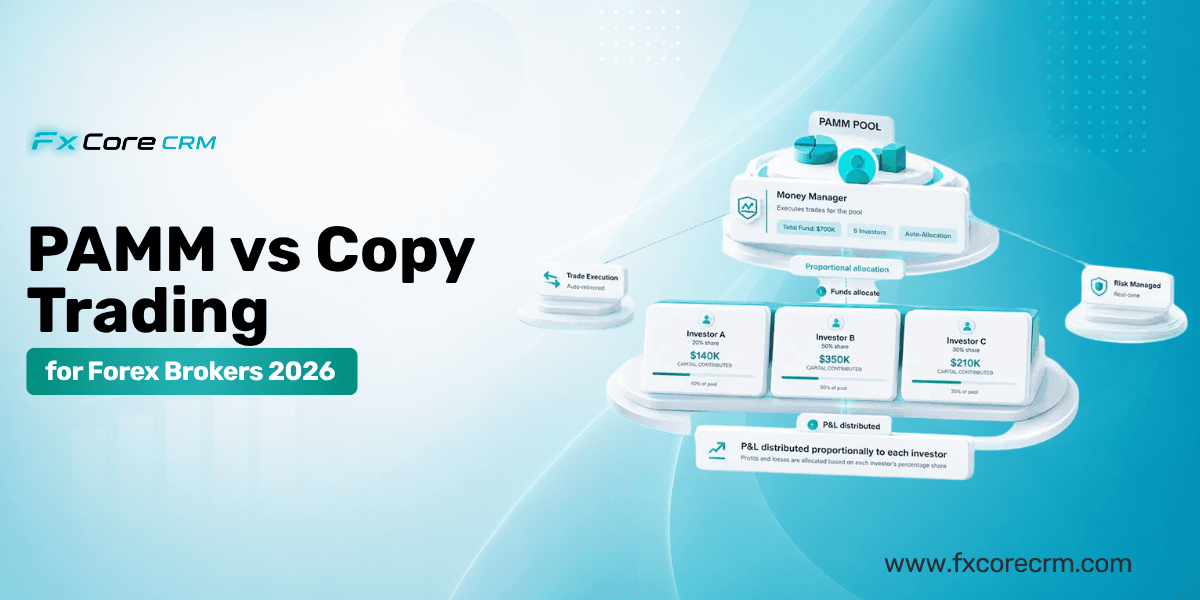
Copy trading replicates individual trades from a signal provider's MT5 account to a follower's separate MT5 account in real time. The follower owns their own account, can stop copying at any moment and sees every trade the signal provider makes. PAMM pools investor capital directly into a fund manager's single MT5 account. Investors do not hold separate accounts — their capital is allocated to the manager's account and profits or losses distribute proportionally. Copy trading is transparent and client-controlled. PAMM is pooled and manager-controlled.
That distinction drives almost every other difference between the two.
How Copy Trading Works
When a signal provider opens a trade on their MT5 account, the copy trading engine detects it through the MT5 integration and automatically opens a proportional trade in every active follower's account. A signal provider trading 1.0 lot on a $10,000 account triggers a 0.5 lot trade in a follower's $5,000 account. When the signal provider closes the trade, the follower's position closes simultaneously.
The follower's experience through the client portal is straightforward — they browse a marketplace of signal providers, review each provider's live performance metrics, subscribe with a click and watch trades appear and close in their account automatically from that point forward.
Every trade is visible. The follower can override individual trades, pause copying temporarily or unsubscribe entirely at any time. Their capital stays in their own MT5 account throughout. They have complete control.
Who copy trading suits:
Copy trading works best for clients who are interested in trading but lack the time, skills or confidence to trade independently. They want to follow a real trader whose results they can verify — not hand their money to a fund manager and wait for a monthly statement. They want transparency, control and the ability to exit quickly if the signal provider's performance deteriorates.
For brokers, copy trading is easier to market to retail clients because the transparency is immediately appealing. "Follow a real trader, see every trade live" is a simpler and more compelling message than "allocate capital to a managed fund."
How PAMM Works
PAMM — Percentage Allocation Money Management — pools investor capital into a single MT5 account managed by a professional trader or fund manager. Investors do not have separate MT5 accounts. Their capital is allocated to the manager's account and participates in the account's performance proportionally.
If the manager's account generates a 10% return, each investor's allocation grows by 10%. If the account loses 5%, each investor's allocation decreases by 5%. Performance and losses distribute proportionally to each investor's share of the pooled capital.
The PAMM module in the forex CRM manages the investor-manager relationships — tracking each investor's capital allocation, calculating performance distribution, handling subscription and redemption requests and generating investor statements. The manager trades through a single MT5 account without any visibility into the individual investor pool behind their account.
Investors see their PAMM account performance — total allocation, current value, historical performance — through the client portal but do not see individual trades unless the manager chooses to disclose them.
Who PAMM suits:
PAMM suits investors who want fully managed capital allocation with minimal involvement in trade monitoring. They are comfortable delegating trading decisions entirely to a professional manager and reviewing results periodically rather than following individual trades in real time.
For brokers, PAMM attracts a higher-value investor profile — clients who are typically depositing larger amounts for managed allocation rather than smaller amounts to try copy trading. PAMM is a stronger fit for brokers targeting high-net-worth clients, corporate investors or clients who already invest in managed funds and understand the model.
Key Differences Brokers Must Understand
Account Structure
In copy trading, every follower has their own individual MT5 account. The broker manages a growing number of individual accounts as copy trading subscriber volumes grow. Each account has its own balance, equity, margin and trading history.
In PAMM, investors do not have individual MT5 trading accounts. Their capital allocates to the manager's account. The broker manages far fewer MT5 accounts because investor participation is represented as allocation shares in the manager's account rather than as separate client accounts.
This has significant operational implications. A copy trading system with 500 active subscribers requires the broker's MT5 infrastructure to handle 500 additional client accounts executing trades simultaneously whenever the signal provider trades. A PAMM system with 500 investors requires the MT5 infrastructure to handle one account — the manager's — regardless of investor count.
Client Control
Copy trading gives clients maximum control. They see every trade, can modify proportional sizing, can override individual trades, can pause copying and can exit immediately by unsubscribing. Their capital is always in their own account and accessible at any time.
PAMM gives clients minimal control. They allocate capital to the manager and receive performance results. They can typically request redemption according to the fund's terms — which may have lock-up periods or withdrawal notice requirements — but they cannot intervene in individual trades. They trust the manager's discretion entirely.
Transparency
Copy trading is completely transparent by design. Followers see the signal provider's complete live trading history — every position opened, every position closed, every result. This transparency is the primary appeal of copy trading for retail clients who are naturally skeptical of investment products they cannot verify independently.
PAMM is as transparent as the manager chooses to make it. Investors see their account performance but do not see individual trades unless the manager publishes them. This is appropriate for professional fund management contexts where trade disclosure could undermine the strategy but is less compelling for retail clients who want to see what they are following.
Revenue Model
In copy trading, the broker typically earns revenue from signal provider subscription fees — taking a percentage of the monthly fee that copiers pay signal providers — plus the standard spread and commission income from the additional trading volume generated by copier accounts.
In PAMM, the broker earns from performance fees — taking a percentage of the management fee or performance fee that investors pay to the fund manager — plus spread and commission income from the manager's trading activity, which now represents pooled investor capital.
Both models can be highly profitable. Copy trading generates more spread income because more individual accounts are trading simultaneously. PAMM generates potentially larger fee income per client because investors allocate larger amounts to managed funds than they typically deploy in copy trading subscriptions.
IB Network Integration
Copy trading creates powerful IB incentives because IBs who are skilled traders can become signal providers — attracting followers through their referral network while earning IB commission on every follower's trading activity simultaneously. The dual income from signal provider subscription fees and IB commission is a strong motivator for IB promotion.
PAMM creates IB incentives through a different mechanism — IBs who refer investors to PAMM funds earn ongoing IB commission on the trading volume generated by those investors' allocations. IBs who refer high-value investors to well-performing PAMM managers earn significant ongoing commission with minimal ongoing effort after the initial introduction.
Which One Should Your Brokerage Offer?
The honest answer for most forex brokers in 2026 is both — because copy trading and PAMM serve different client segments that exist in virtually every retail broker client base simultaneously.
Launch copy trading first if:
Your primary client base is retail traders with accounts under $10,000 who are new to forex and attracted to the transparency and control of following live traders. Copy trading is easier to understand, easier to market and easier for clients to get started with immediately.
Your IB network includes traders who would make good signal providers — people with genuine trading track records who can attract followers from their own networks. Copy trading IB incentives are particularly strong in Middle Eastern and Indian markets where WhatsApp-based trading communities and Telegram signal groups already exist as a distribution channel.
Your forex CRM platform already has copy trading built in — making implementation straightforward rather than requiring a separate platform integration.
Launch PAMM if:
Your brokerage targets higher-net-worth clients, corporate investors or clients from markets where managed fund investment is culturally familiar and preferred over self-directed or copy trading approaches.
You have access to professional traders or fund managers with documented track records who are willing to manage PAMM funds on your platform — because PAMM without high-quality managers has nothing for investors to allocate to.
You are expanding into markets where regulated PAMM products have existing demand — some European and Middle Eastern markets have established investor appetite for managed forex fund products.
The strongest brokerage offering combines both — copy trading for the retail client majority seeking transparent, controlled social trading exposure, and PAMM for the smaller but higher-value investor segment seeking fully managed allocation. FxCore CRM includes both the copy trading module and the PAMM module as built-in platform components — the broker does not need separate systems for each.
Operational Requirements Compared
Copy trading operational requirements:
The broker needs a trade replication engine with low-latency MT5 connection, a signal provider marketplace in the client portal with live performance metrics, subscription management in the forex CRM and MT5 infrastructure capable of handling proportional trade execution across all active copier accounts simultaneously.
The operational complexity grows with subscriber volume — more active copy trading accounts means more simultaneous trade execution events when signal providers trade. MT5 server capacity planning must account for peak trade replication loads during high market activity periods.
PAMM operational requirements:
The broker needs a PAMM module in the forex CRM that manages investor allocations, calculates performance distribution accurately, handles subscription and redemption requests and generates investor statements. The MT5 infrastructure requirement is simpler than copy trading because the manager trades through a single account regardless of how many investors are allocated to it.
The operational complexity in PAMM centers on calculation accuracy — performance distribution calculations must be mathematically precise across all investor allocations to avoid disputes. Performance fee calculations, high watermark tracking and allocation percentage changes when new investors join or existing investors redeem all require accurate calculation logic.
FxCore CRM — Both Copy Trading and PAMM Built In
FxCore CRM delivers both copy trading and PAMM as built-in modules integrated with the same native MT5 connection, the same white-label client portal and the same IB management system — no separate platforms required.
Brokers who want to launch both copy trading and PAMM simultaneously do so from a single platform implementation rather than managing two separate technology stacks alongside their core forex CRM solution.
Platform statistics:
- 250+ active forex broker clients globally
- 370+ total integrations
- 340+ successfully delivered projects
- Dubai, UAE headquarters
- 24/7 technical support
Request a free demonstration at https://fxcorecrm.com/request-demo
Contact: [email protected] | WhatsApp: +971 5557 14507
Frequently Asked Questions
Q: What is the main difference between PAMM and copy trading?
Copy trading replicates trades from a signal provider's account to individual follower accounts in real time — each follower retains their own MT5 account and full control.
Q: Which is better for retail forex clients — PAMM or copy trading?
For typical retail forex clients, copy trading is generally more accessible — the transparency of following real trades in real time is easier to understand and more immediately appealing than allocating capital to a pooled fund.
Q: Can a forex broker offer both PAMM and copy trading?
Yes — and most competitive brokers should. Copy trading serves the retail majority while PAMM serves the higher-value investor minority. FxCore CRM includes both copy trading and PAMM modules as built-in components — no separate platform implementation required for either.
Q: Does FxCore CRM support both copy trading and PAMM?
Yes. FxCore CRM includes both copy trading and PAMM as built-in platform modules integrated with the native MT5 connection, client portal and IB management system. Request a demonstration at fxcorecrm.com/request-demo.
FxCore CRM is a forex technology provider headquartered in Dubai, UAE. The platform does not provide financial services or investment advice.