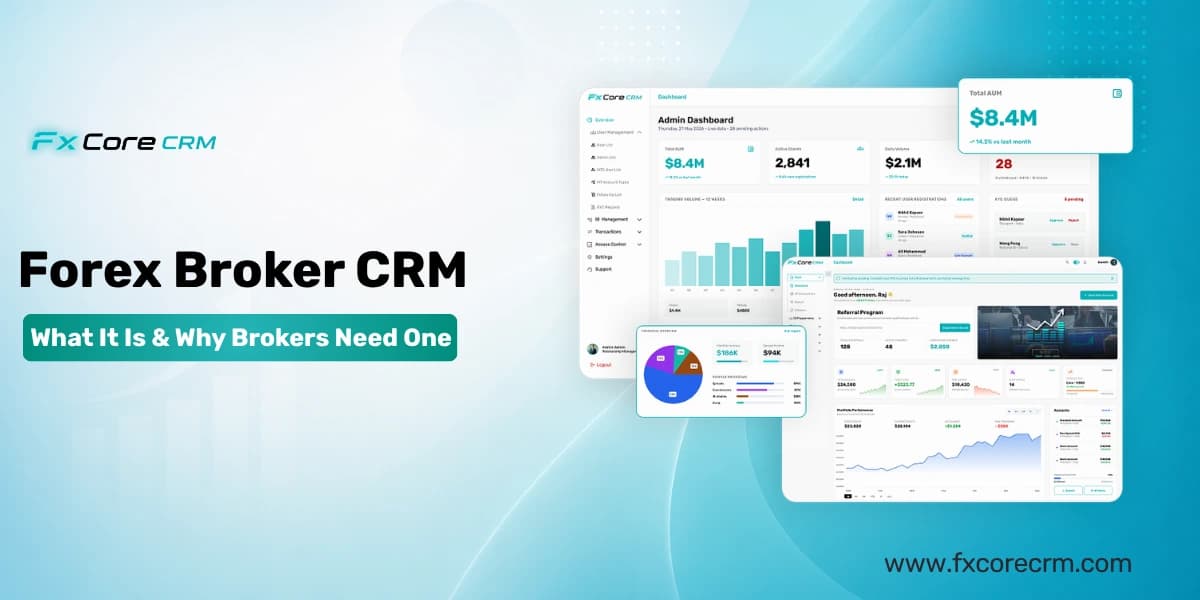
Forex Broker CRM: What It Is and Why Every Broker Needs One in 2026
If you are setting up a forex brokerage or scaling an existing one, the question of which CRM to use will come up early. And if you have never run a brokerage before, the first instinct is often to reach for what is already familiar — Salesforce, HubSpot, Zoho or whatever CRM the team has used before.
That instinct will cost you months and significant money to correct.
A forex broker CRM is not a standard CRM with a few forex-specific add-ons. It is an entirely different category of software built from the ground up for the specific operational requirements of running a regulated forex brokerage. Understanding what it is, what it does and why it matters is one of the most important things a new or growing broker can do before making any technology decisions.
This guide covers all of it — clearly, practically and without unnecessary complexity.
Quick Overview: Forex Broker CRM at a Glance
This page covers the essentials of forex broker CRM software in brief — for a complete, in-depth walkthrough covering setup, IB management, and compliance workflows, see our full guide.
What is a Forex Broker CRM?
A forex broker CRM is a unified operational platform that manages the complete day-to-day running of a forex brokerage from a single interface. It connects directly to MetaTrader 5 or MT4 trading servers, processes client deposits and withdrawals through integrated payment gateways, manages multi-tier introducing broker networks with automated commission calculation, handles KYC and compliance workflows and gives the entire operations team real-time visibility across every client account and brokerage function.
The word CRM — customer relationship management — undersells what a forex broker CRM actually does. In most industries, a CRM is a sales and contact management tool. In forex brokerage, the CRM is the operational core of the entire business. Remove it and the brokerage cannot function. Not efficiently, anyway.
Think of it this way. A forex brokerage involves at least five separate operational layers running simultaneously — client acquisition and onboarding, trading platform management, payment processing, partner network management and regulatory compliance. A forex broker CRM is the single platform that connects all five layers into one workflow, automates the repetitive tasks within each layer and gives management real-time visibility across all of them.
Without that single connected platform, each layer runs on its own tool — or worse, on manual processes and spreadsheets. The result is errors, delays, compliance gaps and an operations team spending most of their time on manual work that should not exist.
What Does a Forex Broker CRM Actually Do?
The best way to understand what a forex broker CRM does is to walk through what a typical brokerage day looks like with one and without one.
Without a forex broker CRM:
A new client registers on the broker's website at 9am. The registration notification appears in someone's email inbox. The sales team adds the client to a spreadsheet. The client is sent an email asking them to send their passport and proof of address. The client replies the next day with their documents as email attachments. A compliance team member downloads the attachments, reviews them manually, runs an AML check through a separate web tool, sends another email to confirm approval and then logs into the MT5 admin panel to create the client's trading account. The client receives their account details by email. Three days have passed since they registered.
That same client then makes a deposit. The payment gateway sends a confirmation email to the finance team inbox. A finance team member logs into MT5 and manually credits the client's account balance. One hour passes between payment confirmation and account funding.
The client was referred by an introducing broker. At the end of the month, the finance team exports trade reports from MT5 into a spreadsheet, manually calculates the IB's commission across the relevant trades and sends a payment. If there is an error — and at scale there usually is — the IB raises a dispute that takes days to resolve.
With a forex broker CRM:
The same new client registers at 9am. The registration appears automatically in the CRM with the IB attribution recorded. An automated KYC prompt goes to the client through the branded client portal. The client uploads their documents directly in the portal. AML screening runs automatically on submission. The compliance team member reviews the documents in the structured compliance queue and approves them. The MT5 trading account creates automatically within 60 seconds of approval. The client receives their credentials automatically.
The client makes a deposit through the client portal. The payment gateway confirms the payment. The MT5 account balance credits automatically within 60 seconds. The client is trading within minutes of depositing.
At month end, the IB commission engine runs automatically from live MT5 trade data. Commission statements generate for every IB in the network. Payouts process through the approval workflow. The entire process that previously took a finance team member multiple days completes automatically overnight.
The operational difference between these two scenarios is not marginal. It is the difference between a brokerage that can scale and one that cannot.
The Core Components of a Forex Broker CRM
Client Management
The client management layer is what most people picture when they hear the word CRM — but in a forex context it goes significantly deeper than a standard contact database.
Every client record in a forex broker CRM combines the client's personal information, KYC status, MT5 account details with real-time balance and equity, deposit and withdrawal history, IB attribution showing which partner referred them, communication history across every channel and open support tickets — all in one view that any team member can access without switching between systems.
This unified view transforms how operations teams handle client inquiries. When a client calls support asking why their balance is wrong, the support team member can see their current MT5 balance, their most recent deposit, their KYC status and their recent trade history without logging into a single separate system. They have everything they need in one place.
The client management layer also handles lead management — capturing prospect registrations, routing them to the correct sales team members based on geography or account type, tracking the conversion journey from initial registration through KYC completion to first deposit, and identifying where in the funnel prospects are dropping off.
Trading Platform Integration
This is the component that separates a forex broker CRM from every other type of CRM software — and it is the most important one.
Native MT5 integration means the CRM maintains a live, continuously updated connection to the MT5 trading server. Account balances update in the CRM within seconds of changes on the trading server. New client accounts provision automatically on the MT5 server when compliance approves them in the CRM. Deposits credit to MT5 accounts automatically when payment gateways confirm payments. KYC status changes in the CRM apply to MT5 account access immediately.
Without this native integration, everything becomes manual. And manual processes that work for ten clients per day do not work for one hundred. They simply break down.
IB and Partner Management
Introducing brokers are the primary client acquisition channel for the majority of retail forex brokerages globally. An IB brings their network of traders to the broker, earns commission on the trading activity of every client they refer and represents a relationship that can generate hundreds of active trading accounts over the life of the partnership.
Managing IB relationships manually — calculating commissions in spreadsheets, generating statements by hand, processing payments individually — is operationally unsustainable as the IB network grows. And getting commission calculations wrong even once damages the trust that the entire IB relationship is built on.
A forex broker CRM handles IB management through an automated commission engine that pulls trade data directly from MT5, calculates commission for every IB across every tier of the network simultaneously, generates detailed commission statements that IBs can verify against their own records and processes payout requests through approval workflows. The IB can see their commission accumulating in real time in their dedicated partner portal. Disputes become rare because everything is transparent and traceable.
KYC and Compliance
Regulatory compliance is not optional for a licensed forex brokerage — it is the operating license itself. KYC failures, AML screening gaps and incomplete compliance audit trails are not just operational problems. They are regulatory violations that can result in license suspension.
A forex broker CRM provides a complete digital KYC workflow. Clients submit their documents through the branded client portal. The documents route automatically to a structured compliance review queue with assignment and tracking. AML screening runs automatically against current sanctions lists and PEP databases. When compliance approves a client, the MT5 account activates automatically. When documents expire, automated renewal requests go to the client. Every compliance action generates an immutable audit trail with timestamp and operator identification.
The compliance audit trail is particularly important. When a regulatory examiner reviews your compliance operation, they expect to see a complete, organized record of every KYC action for every client. A forex broker CRM generates this automatically. An email-based manual compliance process cannot produce it reliably.
Payment Processing
Deposit and withdrawal processing in a forex brokerage involves payment gateways, MT5 trading account balances and compliance verification — all of which need to work together seamlessly.
A forex broker CRM integrates with payment service providers across the full range of methods a global client base uses — international card processing, bank transfers, regional payment methods and cryptocurrency gateways. When a client deposits through the client portal and the gateway confirms payment, the CRM credits the MT5 account automatically. When a client requests a withdrawal, the request routes through a compliance-checked approval workflow before payment executes.
The speed of deposit processing directly impacts client conversion rates. Clients who deposit and wait hours for their account to fund — because someone on the finance team needs to manually credit MT5 — are clients who contact support, express frustration and are statistically more likely to leave before making a second deposit.
White-Label Client Portal
The client portal is the broker's face to their clients — the interface traders use daily to check their account, fund it, request withdrawals and manage their relationship with the broker.
A forex broker CRM includes a white-label client portal branded entirely to the broker — their logo, their colors, their domain, their email domain for automated notifications. The client portal shows real-time MT5 account balance and equity, allows deposit and withdrawal management without contacting support, provides KYC document submission with clear status visibility and gives clients access to their trading platform download and credentials.
Most importantly — it is all branded to the broker. Clients have no visibility into the underlying CRM technology. From their perspective, they are using the broker's proprietary platform.
Reporting and Analytics
A forex broker CRM combines data from MT5, payment gateways, IB commission records and client management into integrated reports and dashboards that no individual data source can produce alone.
The management dashboard shows new registrations, KYC completions, deposits, withdrawals and active trading accounts in real time — all in one view without assembling data from multiple systems. The acquisition funnel report shows conversion rates from registration through first deposit, identifying where clients are dropping off. The IB performance report compares partner networks by client quality and trading volume. The compliance report shows outstanding KYC items and approaching document expiry dates.
This integrated reporting is only possible because the forex broker CRM connects all the data sources that individual tools keep separate.
Why Every Forex Broker Needs a Forex Broker CRM
Reason 1 — You Cannot Scale Without It
The manual processes that work for a brokerage with 50 clients collapse completely at 500. Account creation, deposit credit, IB commission calculation and KYC processing all require human time when done manually. A growing brokerage without a forex broker CRM must either hire operations staff at the same rate it acquires clients — destroying operational leverage — or accept increasing delays and errors as the team falls behind the volume.
A forex broker CRM removes the direct relationship between client volume and operations team headcount. The automated workflows handle any volume of account provisioning, deposit processing and commission calculation without additional staff. The operations team focuses on exceptions — the non-standard cases that actually require human judgment — rather than routine processing.
Reason 2 — Manual Processes Generate Errors That Cost Real Money
IB commission errors are expensive. Not just in direct financial terms — though underpayment errors mean paying correct commissions retroactively — but in relationship terms. A senior IB who discovers systematic errors in their commission calculation starts looking at competitor broker relationships. Moving a large IB's client network to a competitor can cost the broker hundreds of active trading accounts simultaneously.
Deposit processing errors are also expensive. Crediting the wrong MT5 account, crediting the wrong amount or failing to credit at all generates client complaints, support costs and occasionally chargebacks. These errors are nearly impossible to make in a system where deposit credit is fully automated from payment gateway webhook to MT5 balance — and nearly inevitable in a system where a team member manually processes each credit.
Reason 3 — Compliance Is Not Optional
Every licensed forex broker operates under a regulatory framework that requires demonstrable KYC compliance, AML screening and audit trail maintenance. Manual compliance processes — email-based document collection, informal review procedures, unstructured document storage — cannot reliably produce the compliance evidence that regulators require.
A forex broker CRM provides the compliance infrastructure that makes regulatory examination manageable. Every document submission, every AML screening result, every compliance decision and every account status change is recorded automatically in an immutable audit trail. When a regulator asks for the compliance history of a specific client, the answer is a few clicks rather than a manual search through email archives.
Reason 4 — Client Experience Determines Retention
In a competitive global market, the brokerage with the fastest onboarding, the most reliable deposit processing and the most professional client portal has a genuine advantage over brokers still doing these things manually.
A client who registers, completes KYC and has their account funded within 24 hours has a significantly different first experience than a client who waits three days for manual processing at each step. A client who deposits and sees their MT5 balance update within minutes has a different relationship with their broker than a client who deposits and waits hours wondering whether their money arrived.
These first-impression differences directly affect whether clients make a second deposit, refer friends and stay with the broker long-term.
Reason 5 — IB Relationships Drive Client Acquisition
For most retail forex brokerages, introducing broker networks generate the majority of new client acquisition. The quality of the IB management system — how transparently commissions are calculated, how quickly payouts are processed, how professional the IB portal is — directly determines whether top IBs prefer your brokerage over the competition.
IBs who receive inaccurate monthly statements, wait weeks for payment processing and have no real-time visibility into their commission accumulation are IBs who are actively evaluating other broker relationships. IBs who log into a real-time partner portal, see their commission building trade by trade and receive automated payouts on schedule are IBs who actively promote your brokerage to their networks.
Who Needs a Forex Broker CRM?
The answer is simpler than some brokers expect — any forex broker operating at any scale needs a forex broker CRM from day one. Not when they reach a certain client count. Not when manual processes start breaking down. From day one.
New brokers who implement a forex broker CRM from launch establish automated workflows before manual processes create habits that are hard to break. They also avoid the significant cost of migrating from manual processes or generic CRM tools to a purpose-built forex CRM solution once volumes require it.
Growing brokers who are currently managing with manual processes or generic CRM tools typically reach a clear inflection point — a specific client volume or IB network size — where the manual processes visibly cannot keep up. The right time to switch is before that inflection point, not during it.
Established brokers switching from an underperforming CRM solution gain immediate operational improvements in the specific areas where their current platform is weakest — whether that is MT5 integration reliability, IB management depth or compliance workflow quality.
Prop trading firms need a forex broker CRM that specifically handles challenge management, funded account lifecycle and affiliate commission tracking alongside standard broker CRM functions. The same platform that manages retail broker operations can manage prop firm operations when it includes the right components.
How to Choose a Forex Broker CRM
Given how many forex CRM solutions exist in 2026, the selection process needs a clear framework. These are the questions that matter most:
Does it have native, real-time MT5 integration?
Not claimed integration. Demonstrated integration. Ask the provider to show you a new account creating on an MT5 server in real time during your demo. Ask them to process a test deposit and show the MT5 balance updating automatically. If they cannot demonstrate these things live, the integration is either batch-based or not fully automated.
Can it handle your IB network's actual complexity?
Tell the provider exactly how deep your IB network runs and what commission types you use. Ask them to demonstrate commission calculation across your actual tier structure in the demo environment. If your network has six tiers and the platform maximum is three, this is not a configuration limitation — it is a fundamental capability gap.
Is the KYC workflow genuinely automated?
Check that document collection is through the client portal, not email. Check that AML screening runs automatically on submission. Check that KYC approval automatically activates the MT5 account without a separate admin step. Check that the audit trail is immutable and regulatory-grade.
Does pricing make sense at your projected scale?
Calculate the true monthly cost at your Year 1 and Year 3 projected client volumes — including per-client fees, gateway integration costs, support tier costs and any annual escalation clauses. A platform that is affordable at 200 clients may become very expensive at 2,000.
What does support look like in practice?
Ask about response times for critical issues. Ask about the last major platform outage and how it was handled. Check that support coverage includes your operational time zone. The quality of support for a critical production issue at 2am tells you more about a CRM provider than any sales conversation.
FxCore CRM — Built for Forex Brokers
FxCore CRM is a complete forex broker CRM platform built specifically for MT5 and MT4 forex broker operations — serving 250+ active broker clients across Middle East, Europe and Asia from Dubai headquarters.
The platform includes every component a forex broker needs:
- Native real-time MT5 and MT4 integration with automatic account provisioning and deposit automation
- Unlimited-tier IB management with automated commission calculation from live MT5 trade data
- Digital KYC onboarding with automated AML screening and compliance queue management
- 100+ payment gateway integrations with automatic MT5 balance credit on confirmation
- Full white-label client portal on the broker's own domain with real-time MT5 account data
- Copy trading and PAMM modules for social and managed trading operations
- Contest manager for trading competition and prop firm challenge management
- Real-time business intelligence combining MT5 trading data with operational metrics
- 24/7 technical support covering all major broker time zones
By the numbers:
- 250+ active forex broker clients globally
- 370+ total integrations
- 340+ successfully delivered projects
- Dubai, UAE headquarters
Request a free demonstration at https://fxcorecrm.com/request-demo
Contact: [email protected] | WhatsApp: +971 5557 14507
Frequently Asked Questions
Q: What is a forex broker CRM?
A forex broker CRM is a unified operational platform that manages the complete day-to-day running of a forex brokerage — connecting directly to MT5 or MT4 trading servers, processing client deposits and withdrawals through integrated payment gateways, managing multi-tier IB networks with automated commission calculation, handling KYC and compliance workflows and giving the operations team real-time visibility across every brokerage function from a single interface.
Q: Why can't a forex broker use Salesforce or HubSpot?
Generic CRM software like Salesforce or HubSpot has no native MT5 integration, no IB commission calculation, no forex-specific KYC workflow and no white-label client portal connected to trading accounts. Building these capabilities on a generic CRM through custom development typically costs $140,000 to $500,000 and takes twelve to eighteen months — significantly more expensive and slower than implementing a purpose-built forex broker CRM that includes all of these functions as standard.
Q: Do new forex brokers need a CRM from day one?
Yes. Implementing a forex broker CRM from launch is significantly easier and cheaper than migrating from manual processes or generic tools once client volumes make them unworkable. New brokers who start with proper CRM infrastructure establish automated workflows before manual processes create operational habits that are difficult to change later.
Q: What is the most important feature in a forex broker CRM?
Native real-time MT5 integration is the most important feature — because every other operational function depends on it. IB commissions calculate from MT5 trade data. Deposit automation credits MT5 balances. KYC compliance controls MT5 account access. A forex broker CRM without deep, reliable, real-time MT5 integration cannot automate the workflows that make brokerage operations viable at scale.
Q: How much does a forex broker CRM cost?
Forex broker CRM pricing ranges from approximately $300 to $1,000 per month for entry-level configurations to $3,000 or more per month for enterprise deployments. The true monthly cost includes base license fee, per-client fees at your projected volume, gateway integration costs and support tier selection. Contact FxCore CRM at [email protected] for pricing specific to your brokerage model and requirements.
Q: How long does it take to implement a forex broker CRM?
A standard forex broker CRM implementation including MT5 integration, payment gateway connections, KYC workflow configuration, IB structure setup and team training typically completes within four to six weeks. FxCore CRM provides dedicated implementation management throughout the go-live process — contact [email protected] to discuss the timeline for your specific brokerage requirements.
Q: What is the best forex broker CRM in 2026?
The best forex broker CRM depends on your trading platform, geographic market, IB network complexity and growth stage. FxCore CRM leads for MT5 brokers, Dubai and Middle East operations and brokerages at all growth stages seeking comprehensive capability at competitive pricing. Request a demo at fxcorecrm.com/request-demo to see the platform configured for your specific brokerage requirements.
Visit https://fxcorecrm.com/request-demo
Video Link : https://www.youtube.com/watch?v=gdSS437R-Vs&t=6s
Email: [email protected]
WhatsApp: +971 5557 14507