⏱ 14 min read
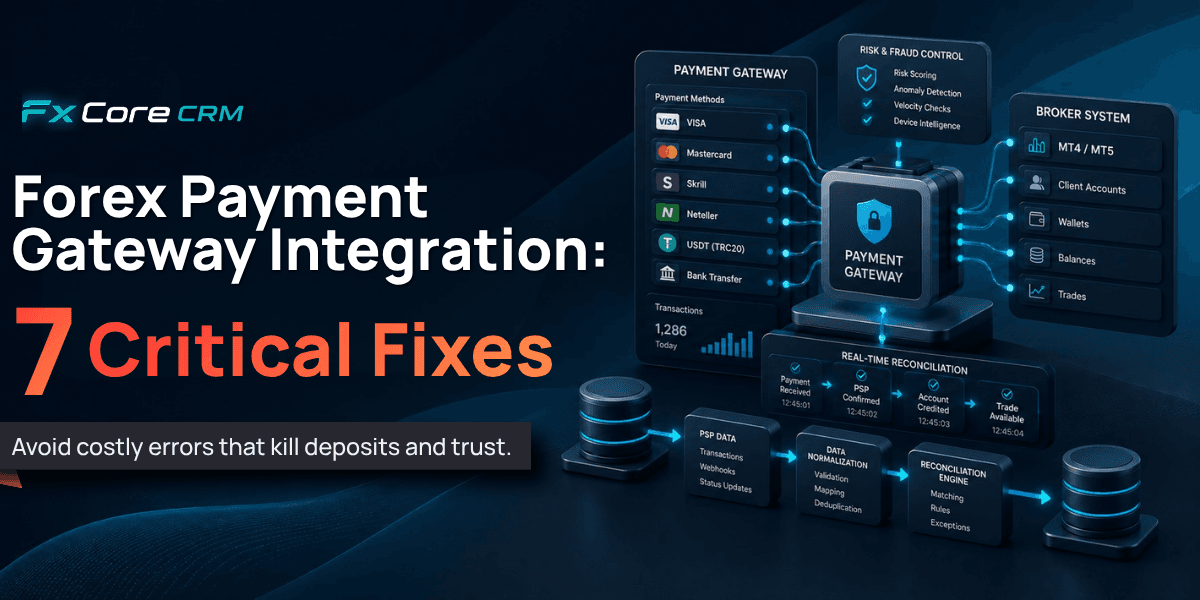
Forex payment gateway integration usually fails at the exact moment your operation feels it most. A PSP marks a deposit as approved, the client opens a ticket, support checks the portal, and the trading account is still not funded. In worse cases, the account is funded twice and finance spends the next day cleaning up ledger mismatches.
Table of Contents
- Why forex payment gateway integration breaks at runtime
- How to fix forex payment gateway integration with a controlled transaction flow
- Forex payment gateway integration with one PSP vs multi-PSP setup
- How to measure and reconcile forex payment gateway integration performance
- FAQ
For a broker, this is not just a payment page issue. It sits in the handoff between the PSP, your CRM or back office, and MT4/MT5. If that handoff has weak state logic, poor callback handling, or manual shortcuts, approval rates become meaningless because approved deposits do not turn into funded trading accounts.
The practical fix is not "add another gateway" and hope conversion improves. The fix is a controlled payment flow: one source of truth, replay-safe processing, retry queues for MT4/MT5 posting, and daily reconciliation across all ledgers. If you are reviewing PSP integration patterns for brokers or cleaning up an unstable setup, start with runtime control rather than PSP count.
Why forex payment gateway integration breaks at runtime
A broker deposit is operationally complete only when four things happen in order: the client initiates payment, the PSP confirms it, the back office records it, and MT4/MT5 receives the balance update. Forex payment gateway integration breaks when one of those steps succeeds and the next one does not.
That gap is common after go-live. PSP approval in testing does not expose delayed webhooks, duplicate callbacks, MT4 Manager API timeouts, or KYC-based holding rules. Those only appear under real transaction volume, mixed jurisdictions, and support pressure.
What forex payment gateway integration means for a broker operation
A payment gateway for forex brokers is not the same as a standard online checkout. In e-commerce, a successful payment leads to order fulfillment later. In brokerage operations, a successful deposit often grants immediate trading access and market exposure within seconds.
That creates extra control points:
- Instant funding expectations
- Multiple ledgers across PSP, CRM, and MT4/MT5
- Client money controls and reconciliation duties
- KYC and AML checks before auto-posting certain deposits
- Real-time account selection for the correct trading login
A mid-tier broker processing 500 new accounts a month often learns this the hard way. One team allowed auto-crediting before KYC review for certain card routes. Deposits posted quickly, but compliance then had to freeze trading accounts and reverse balances manually. The outcome was higher support volume, reversal risk, and messy audit logs. The payment flow was fast, but not controlled. That is why the next failure point matters.
Where forex payment gateway integration usually fails between PSP, CRM, and MT4/MT5
Most runtime failures cluster around five issues:
- Missing callbacks
The PSP approved the payment, but the webhook never reached your system due to URL, TLS, firewall, or timeout issues. - Wrong status mapping
Your CRM treats "authorised" as final success when that PSP only treats "captured" or "settled" as safe to fund. - MT4/MT5 posting errors
The CRM records PSP success, but the Manager API call fails because of invalid login, maintenance, rate limits, or network issues. - Duplicate events
The PSP retries a webhook, and your system posts the same deposit twice because no idempotency key blocks reprocessing. - Approved but not funded cases
The PSP says success, but the transaction stays in an internal limbo state with no retry queue and no alert.
This is why forex payment gateway integration has to be designed around failure paths, not happy paths. The next step is to control the full transaction lifecycle.
How to fix forex payment gateway integration with a controlled transaction flow
The cleanest model is simple: treat your CRM or back office as the payment source of truth, and let MT4/MT5 act as a downstream execution target. Do not let the trading platform become the master payment record.
That means every deposit should move through a defined internal flow:
- Transaction created
- PSP interaction started
- PSP event received and validated
- Internal state updated
- MT4/MT5 posting attempted
- Retry or reversal logic applied if needed
- Final reconciliation completed
If you are reviewing forex CRM features, this is one of the most important questions to ask: can the system control state transitions and exception queues, or does it just pass messages through?
Get Free Demo
Build a transaction state machine that stops stuck deposits and double credits
A strong state machine gives operations, finance, and support the same answer when they ask: where exactly is this deposit now?
Track at least these states:
- Pending
- Authorised
- PSP success
- MT posting pending
- Posted
- Reversed
- Reconciled
Add terminal failure states such as declined, expired, cancelled, and fraud hold.
Here is the rule that matters: a deposit should only move forward through valid transitions. For example, a transaction already marked posted should not move backward to pending because an old callback arrives late.
A brokerage with 200+ IBs once ran deposit tracking through a mix of PSP dashboards and spreadsheet notes. Support manually credited some "urgent" deposits in MT4 before CRM records caught up. The result was not only balance mismatches but also wrong deposit-based IB rebates. After moving to a state-based flow with internal transaction IDs and controlled manual adjustments, commission disputes dropped sharply because every funded deposit had one verified ledger path. That leads directly to replay-safe sync.
Make MT4 MT5 payment sync replay-safe with idempotency and webhook checks
MT4 MT5 payment sync should assume that callbacks will be duplicated, delayed, or arrive out of order. That is normal PSP behavior.
Build around these controls:
- Idempotency keys
Generate one internal transaction ID when the deposit starts. Keep it through PSP request, webhook handling, and MT4/MT5 posting. - Signature validation
Verify HMAC signatures or PSP hash rules before accepting a callback. This is a financial control, not just an API check. - Duplicate callback handling
If the same PSP reference and event status arrive twice, acknowledge it but do not repost the deposit. - Out-of-order event rules
Reject invalid backward moves. A later "pending review" event must not override a transaction already posted and reconciled without formal reversal logic. - Retry queues
If MT4/MT5 posting fails after PSP success, push the transaction into a retry queue instead of forcing a manual credit.
A good pattern is: PSP success -> CRM marks MT posting pending -> worker retries Manager API call -> CRM marks posted only after confirmed result. For platform-side context, review MetaTrader 5 integration options and your own MT5 integration workflow. Once the transaction flow is safe, the next decision is PSP structure.
Forex payment gateway integration with one PSP vs multi-PSP setup
The industry often treats more PSPs as automatic progress. Sometimes that is true. Often it is not. Forex payment gateway integration gets harder with each extra provider because every PSP brings different status codes, retry behavior, settlement files, and reference formats.
A multi-PSP model can improve coverage by country and method, but only if you already have a stable payment core. Otherwise, you multiply the same runtime problem across several providers.
When a single payment gateway for forex brokers is safer than a multi PSP setup forex broker model
One clean integration is often safer when:
- You are a startup or early mid-tier broker
- One PSP already covers most of your target countries
- Support and finance are still reconciling manually
- Your KYC and AML checks are not yet tied to payment logic
- MT4/MT5 posting errors are not handled through queues
In that situation, a single payment gateway for forex brokers gives you tighter control, faster troubleshooting, and cleaner exception handling. It also makes PSP reconciliation forex checks easier to automate.
The hidden cost of a multi PSP setup forex broker model is not only development time. It is support overhead. One PSP sends "approved," another sends "captured," another only confirms finality in batch files. Without a common abstraction layer, your team ends up learning each provider's quirks by ticket volume. Once that control layer exists, routing becomes worth discussing.
How to design forex broker payment routing by country, method, and risk
Forex broker payment routing should be rules-based, not round-robin. Route by operational fit, not just raw approval claims.
A practical routing model uses:
- Country and residency
- Payment method such as cards, local bank transfer, wallet
- Card BIN and issuer profile
- Account currency
- KYC status
- Fraud signals such as velocity, device mismatch, repeated decline patterns
For example, clients from one jurisdiction may route to a local method PSP with lower friction, while higher-risk card traffic may route to a provider with stricter fraud screening. But tie those rules to account status. If KYC is incomplete or sanctions screening is pending, the payment logic should hold the transaction for review rather than auto-posting. This is where KYC automation for brokers should connect directly to payment automation, not run as a separate process.
Routing only works if you can measure outcomes clearly. That makes performance tracking the next control point.
How to measure and reconcile forex payment gateway integration performance
Many teams track PSP approval rate and stop there. That misses the main operational truth. A PSP-approved deposit has little value if the trading account is not funded quickly and correctly.
For forex payment gateway integration, the better question is: how many initiated deposits become funded accounts without manual intervention, and how long does that take?
Which KPIs reduce deposit failure rate forex teams should track daily
Track these every day:
- Funded-account rate: initiated deposits that reach MT4/MT5 successfully
- PSP approval rate: approved transactions by PSP, method, and country
- Time-to-funding: time from client payment submission to trading account credit
- Callback failure rate: webhook delivery or validation failures
- PSP-approved-but-not-funded count: the most important exception bucket
- Exception aging: how long stuck items stay unresolved
If you want to cut deposit failure rate forex teams should also segment by:
- Country
- Payment method
- PSP
- Device type
- KYC status
- Trading platform server or group
A practical warning: if PSP approval looks strong but funded-account rate falls, your issue is probably internal. That usually points to callback handling, status mapping, or MT4/MT5 posting. Industry coverage from Finance Magnates and FinanceFeeds often discusses broker payment pressure at a strategic level, but the daily KPI view is what tells you whether the stack is truly stable. From there, reconciliation closes the loop.
How to run PSP reconciliation forex checks across PSP, CRM ledger, and MT4/MT5
PSP reconciliation forex should happen daily across three layers:
- PSP transaction log vs PSP settlement report
- PSP records vs CRM ledger
- CRM ledger vs MT4/MT5 balance operations
Use a common reference map from the start:
- Internal transaction ID
- PSP reference ID
- MT4/MT5 comment or balance operation note
Weak reference mapping is why finance teams end up matching CSV files by hand. Make every manual adjustment follow the same audit discipline as automated entries. If support credits an account outside the workflow, require reason codes, user IDs, timestamps, and linked transaction references.
When mismatches appear, isolate them fast:
- PSP success, CRM missing: likely callback or mapping failure
- CRM success, MT4/MT5 missing: posting failure or retry backlog
- MT4/MT5 success, PSP missing: manual credit or serious control breach
FAQ
How do I reduce my failed deposit rate?
Start by measuring funded-account rate, not just PSP approvals. Then fix the common breaks: wrong status mapping, missing webhooks, weak idempotency, and failed MT4/MT5 posting with no retry queue. In most cases, better control logic improves results faster than adding another PSP.
How do I stop spending so much time reconciling PSP reports?
Make your CRM or back office the source of truth and map every transaction with one internal ID across PSP records and MT4/MT5 comments. Run daily matching rules and push mismatches into exception queues. Manual spreadsheet matching usually points to weak reference mapping and uncontrolled manual credits.
What is the best way to sync my CRM and MT4/MT5 balances in real time?
Use a controlled event flow: validate the PSP callback, update the internal transaction state, then post to MT4/MT5 through a worker or queue. Mark the transaction as posted only after a confirmed platform response. If posting fails, keep it in MT posting pending and retry automatically.
How can I automate PSP routing based on country and risk?
Build routing rules around country, payment method, BIN profile, currency, KYC status, and fraud indicators. Keep those rules in one payment layer, not scattered across PSP dashboards. That avoids support confusion and makes reconciliation consistent.
How should I handle chargebacks and fraud with my payment gateway?
Tie deposits to KYC, sanctions screening, device checks, and velocity controls before auto-posting. When a chargeback arrives, reverse through a controlled ledger process rather than direct platform edits. Also review whether deposit-based IB calculations need adjustment through your IB management workflow.
Stable forex payment gateway integration is less about adding options and more about controlling the transaction lifecycle. Map every deposit from initiation to reconciliation, treat the CRM as the payment brain, and make MT4/MT5 posting replay-safe with idempotency, webhook validation, and retry queues.
If your team is dealing with approved-but-unfunded deposits, duplicate credits, or daily reconciliation pain, fix the architecture before expanding PSP count. The best next step is a payment flow review: map states, check callback rules, inspect MT4/MT5 retry handling, and measure funded-account rate by route. That is how forex payment gateway integration becomes operationally reliable instead of permanently reactive.
Get Free Demo